Get pre-approved today! Novus Home Mortgage, a division of Ixonia Bank, offers the most diverse set of loan products in the industry. No matter what situation you may face, we set you up for one thing: to help a family get into a home. Novus Home Mortgage has the product mix for every customer
Buying a home is an exciting time for future home owners. Thereβs a lot of buzz surrounding the home buying process, which can unfortunately come with a bit of stress. Knowing what to look for can alleviate that stress and set you up for success.
Hereβs three tips to consider before committing to a propertyβ¦
The most important thing you can do to set yourself up for success in buying a home is to get pre-approved. Getting pre-approved will give you a clear understanding of how much of a home you can afford based on the payment that fits within your budget.
Speaking with a lender will also help you understand other costs outside of a mortgage, such as the cost of taxes and insurance. Does the home have an HOA payment? All of this will need to be considered and fit into your budget.
Another factor to consider is future maintenance costs. If a home is in need of repairs, that should be factored into your budget as well. You should also consider cost of utilities for the home. Luckily, many homebuyers are able to obtain reports on previous utility costs so they have a good estimate.
Researching a location and area is all about your lifestyle and your preferences. One of the most important considerations is where the property is in relation to work and school. Would you prefer a short commute? Can you easily pick children up after school on the ways home? Is it close to public transportation, if needed?
Once you have that nailed down, youβll want to consider the dynamics of the neighborhood. Is a family-friendly neighborhood important to you? What about having shopping nearby. There is no wrong answer, it is completely based on your preference! With nearby shopping tends to come heavier traffic. But that also comes with convenience.
And lastly, always check safety reports. Many local government provide reporting on the frequency and type of crimes committed within their jurisdiction.
Home Inspection
In most cases, inspecting a property comes after an offer has been made, but before closing on the home. In that window of time in-between, youβll want to look at a few crucial elements before signing off.
The first, and most obvious, is to have a property inspection done by a professional. A professional inspector will check everything on the homes exterior and interior. On the outside this includes examining the walls, foundation, roof, and drainage. On the inside, they will check the plumbing system, electrical system, HVAC, appliances, and so forth.
In some cases, it would also be beneficial to have a pest inspection completed. This will check for harmful pests such as terminates that could cause damage to your property.
Title Search
A title search will need to be done on the property before closing to ensure there are no liens or disputes over the propertyβs ownership. Youβll also have the option to purchase title insurance which protects you against future instances of fraud. We recommend having a discussion with a title attorney to see if this is a good option for you.
Proper Permitting
Another thing to check for is to make sure that all renovations and repairs were done properly and received the proper permitting beforehand. You donβt want to be stuck dealing with the previous ownerβs lazy management.
Plenty of people are still moving these days. And if youβre thinking of making a move yourself, you may be considering the inventory and affordability challenges in the housing market and wondering what you can do to help offset those. A new report from Gravy Analytics provides insight into where people are searching for homes and what theyβre prioritizing most right now. That information could help you plan your own move.
One big factor motivating where buyers are going is affordability and thatβs no big surprise. People are relocating to areas that have less expensive housing options. As a result, small cities are thriving. Hannah Jones, Economics Data Analyst at Realtor.com, summarizes why:
βAffordability is still very much front and center . . . a lot of whatβs available is outside of the price range of many buyers. . . . so they look elsewhere for a little more bang for the buck.β
The takeaway for you? If youβre having trouble finding a home that fits your budget, it may help to browse other, more affordable locations nearby.
And, if youβre already expanding your search radius, you may be able to include a location that features your favorite type of destination, like a suburb near the beach or a mountain town. Data shows many other homeowners are making that type of move a priority today. According to the same report from Gravy Analytics:
βWhether itβs the opportunity to enjoy more weekend hikes in the mountains or to wake up to a lakeside sunrise, people are moving to areas that were once thought of as vacation spots.β
Even with todayβs home prices and mortgage rates, hereβs why a move like this could be possible for you. If youβre already a homeowner, the equity youβll get when you sell your current house can help fuel that move and give you the down payment youβd need for your dream home.
Ongoing remote work is another major factor in where people are moving. A recent report from the McKinsey Global Institute says this about recent movement patterns:
βMany of these moves happened because employees untethered from their daily commutes began to care less about how far they lived from the office.β
If youβre a remote or hybrid worker, you donβt have to live in the same city, or sometimes even the same state, as your job. That means you can prioritize other things, like being closer to loved ones, when buying a home.
In fact, the same McKinsey Global Institute report notes for people who moved during the pandemic, 55% reported moving farther from the office. And since remote work is still a popular choice today, homebuyers will likely continue to take advantage of that flexibility.
Lots of people are still moving today. If you want help navigating todayβs inventory or affordability challenges, and expert advice to help you find your ideal home, let's connect.
Each year thousands of Florida vacationers take advantage of the weather, beach, and endless things to do. At the same time, vacation rental property owners are cashing in on the thriving tourism.
Owning vacation rental property in a high tourism area, such as Florida, is a major way to build wealth. For those considering stepping into owning vacation rental property, hereβs a few things to consider.
Long or short term
When buying property as a rental, homeowners have the option to choose long term or short term rentals. Both have pros and cons, but both are a great way to have your mortgage paid by someone else, and receive passive income.
Short term rentals are those geared towards tourists and vacationers. Typically, the property will be rented for a weekend or a week. The major advantage of this is more money is typically charged on a per night basis.
Long term rentals, such as 6 or 12 month leases, are typically geared towards locals or those who are moving to the area. The advantage of this is that your income coming in from the property is more predictable.
Florida also has an additional demand that is unique to our market, and that is βsnowbirdβ or winter rentals. With these type of rentals, a person will rent a condo or house for 1 to 3 months during the winter season.
Building wealth
Buying investment property with the intent to rent out is a great way to build your net worth. Both long term rentals and short term rentals have pros
Your own vacation destination
Another major advantage to owning your own vacation rental property is that you and your family can vacation there whenever you want! Instead of paying money to stay at anotherβs property, you can visit your property that others are paying for.
When looking to finance your vacation rental property, your lender will factor in a few metrics unique to investment property management.
Debt Service Coverage Ratio
Lenders will take into account how much income the property is likely to produce. This is factored into your overall debt-to-income ratio, which we will cover below. The debt service coverage ratio measures how much rental income remains after paying for all costs, such as the mortgage and interest payment, HOA, management fees, ect.
Debt-to-income Ratio and FICO
Though these metrics are not unique to financing investment property, they will be taken into account when determining how much you qualify to borrow. Typically, lenders vacation rental financing requires higher credit scores than financing a home as a primary residence. Your lender can look at your financial position and create a clear mortgage plan for your situation uniquely.
Once you close on your new property youβll have the option to manage yourself, or hire out a management company.
Obviously, managing your own property is not as easy for those who do not live nearby, compared to those who are local and live near their property. One popular way to have your property managed is by hiring a reputable management company, such as a local real estate office that specializes in property management.
Each management office operates differently, but typically a fee is collected from the homeowner based on how much rental money was collected that month
Owning vacation rental property in a high tourism area, such as Florida, is a major way to build wealth. For those considering stepping into owning vacation rental property, hereβs a few things to consider.
]]>As college-bound students prepare for a new chapter, they are about to be faced with a multitude of decisions competing for their attention. But as they ease into their new life on campus, it's a time ripe with opportunity to lay down financial foundations that will serve them long after graduation.
Establishing excellent financial habits during college is the precursor to post-grad success. While conversations often revolve around savings and budgeting, there's one opportunity that is typically overlooked: purchasing a property in the college town. By converting the significant expense of rent during college into an investment, parents can pave the way for their child's future financial foundation. This strategic decision not only provides a tangible lesson in money management but can also become a launchpad to homeownership once they don their graduation caps.
Owning a home in a college town offers several benefits. The most obvious is this purchase can serve as an excellent investment opportunity. Since college towns tend to have a revolving influx of students, properties in college towns generally hold their value and appreciate over time.
In addition to having a place for the student to live while in college, theres also the opportunity to rent out extra rooms to college friends which can help cover the cost of the mortgage. On top of that, this could also familiarize students with landlord responsibilities, providing a valuable life lesson.
Finally, upon graduation, the student can sell the house and use the equity gained as a down payment for their next home. This would provide the student with a major head start in the competitive real estate market as they are entering their adulthood.
Beyond purchasing a property, other strategies can set students up for financial success during their college years. Hereβs some things for students to considerβ¦
Credit Score Management: Learning the importance of and how to maintain a good credit score. One way to do this is by using a credit card responsibly and paying all bills on time. A good credit score will be invaluable when applying for loans or mortgages in the future.
Student Loan Management: Since a majority of students today take out student loans in order to pay for school, learning how to manage student loans well is essential. Always be sure to understand the terms of any student loans, including interest rates, grace periods, and repayment options. Students should keep track of their loan balance and make timely payments to avoid accruing unnecessary interest.
Savings and Budgeting: Even if it's a small amount, building the habit of saving money on a regular basis will be an invaluable lesson. Implementing a budget can help manage income from part-time jobs or allowances, which can help cover college expenses while still setting a little aside.
Avoiding Debt: When possible, avoid unnecessary debt. Credit cards should not be used for impulsive purchases but rather as tools for building credit history and for emergencies. Learning and practicing living within your means is a great habit to build while still in school.
We recommend chatting with a mortgage lender to understand the ins and outs of this unique investment approach, and how to get started. Remember, the goal isn't just to get through college; it's to be prepared for the financial responsibilities that come afterward. A little foresight now can lead to a robust financial future. Let's lay the groundwork today for the homeowners of tomorrow.
For many families, the quest for a dream home isn't just about granite countertops or a spacious backyard. The vicinity and quality of nearby schools play a monumental role in this decision-making process. As families prepare for the 'back to school' season, we diving into how schools impact home prices and what home buyers should take into consideration.
Balancing the Need for Quality Education and Affordable Housing
All parents want the best for their children, which likely includes a top-tier education. However, in some cases, homes in premium school districts come could with a premium price tag. For families on a budget, this presents a hurdle: should they stretch finances for a home in a top-ranked school district or prioritize affordable housing instead?
Talking with a mortgage lender can give you a better idea of the home price range for you to look at. By knowing this, youβll be able to make more education decisions on which school districts to look in.
Consider the Logistics of Getting Kids to School and Work
Logistics is a major reason why a family may consider a move after the school year has already begun!
In many areas, kids donβt necessarily attend a school within close walking distance. Most families have some sort of commute to school. And in the case of living further out for more affordable housing, what impact and stress does that put on a familyβs commute? On top of that, for working parents the proximity of schools to their workplace is just as crucial. A home might be close to a great school, but if it adds an hour to your work commute, the daily grind could become wearisome.
A good realtor can help you navigate looking at neighborhoods that meet your school and commute needs.
Cost of Property Taxes for Schools
Though itβs not always possible to predict how much property taxes will change over time, it is something to take into consideration when buying your next home. Higher property values often mean higher property taxes, and in most areas, these taxes fund local schools. Sometimes, what seems affordable at face value becomes less so when annual property taxes come into play.
How the Quality of a School Can Affect Home Value Over Time
Undoubtedly, a quality school can bolster property values in its district, making your investment in a home event more valuable. Homebuyers should research if their area is expected to expand their school district by upgrading current school, or adding new schools.
On the flip side, a school with challenges could mean trouble is on the horizon for your property value.
Needing to Change School Districts? Moving to the Area Could Be a Wise Move
Every home is districted for a specific school. If a parent, for any reason, wants to send their children to a different district, moving to that area may be the best choice.
In some places, like in Florida, parents can use school choice to enroll their child in a school outside of their district. Unfortunately, that could lead to a long waiting list. The best guarantee to get into that school is to take up residence locally.
A USDA loan is a type of home loan offered by the United States Department of Agriculture (USDA). It is designed to help low- to moderate-income individuals and families buy homes in areas designated as βruralβ, particularly in areas where traditional financing may not be available.
One of the main benefits of a USDA loan is that it is 100 percent financing and does not require a down payment for a USDA loan, making it a great option for those who may not have a lot of savings or are unable to come up with a down payment for a traditional mortgage.
But, despite itβs name, the USDA loan isnβt just for buying property in the countryside. In fact, thereβs many areas near urban areas that still qualify for the USDA loan.
According to USDA loan guidelines, areas that qualify are areas designated as βruralβ according to the latest US Census. Thus, it is based on population of an area. But there are many towns and neighborhoods just outside of urban areas that meet the population qualifications. Or, there are rapidly developing areas that are becoming more urbanized, but havenβt yet been re-designated by the Census.
To see specific areas, check out the map here.
The bottom line is, if youβre looking for a 100 percent financing option, and think you may meet other USDA qualifications, the USDA loan is not one to overlook. Apply today to see if you qualify.
Before you decide to sell your house, itβs important to know what you can expect in the current housing market. One positive trend right now is homebuyers are adapting to todayβs mortgage rates and getting used to them as the new normal.
To better understand whatβs been happening with mortgage rates lately, the graph below shows the trend for the 30-year fixed mortgage rate from Freddie Mac since last October. As you can see, rates have been between 6% and 7% pretty consistently for the past nine months:
According to Lawrence Yun, Chief Economist at the National Association of Realtors (NAR), mortgage rates play a significant role in buyer demand and, by extension, home sales. Yun highlights the positive impact of stable rates:
βMortgage rates heavily influence the direction of home sales. Relatively steady rates have led to several consecutive months of consistent home sales.β
As a seller, hearing that home sales are consistent right now is good news. It means buyers are out there and actively purchasing homes. Hereβs a bit more context on how mortgage rates have impacted demand recently.
When mortgage rates surged dramatically last year, escalating from roughly 3% to 7%, many potential buyers felt a bit of sticker shock and decided to hold off on their plans to purchase a home. However, as time has passed, that initial shock has worn off. Buyers have grown more accustomed to current mortgage rates and have accepted that the record-low rates of the last few years are behind us. As Doug Duncan, SVP and Chief Economist at Fannie Mae, says:
β. . . consumers are adapting to the idea that higher mortgage rates will likely stick around for the foreseeable future.β
In fact, a recent survey by Freddie Mac reveals 18% of respondents say theyβre likely to buy a home in the next six months. That means nearly one out of every five people surveyed plan to buy in the near future. And that goes to show buyers are planning to be active in the months ahead.
Of course, mortgage rates arenβt the sole factor affecting buyer demand. No matter where mortgage rates stand, people will always have reasons to move, whether itβs for job relocation, changing households, or any other personal motivation. As a seller, you can feel confident there is a market for your house today. And that demand is pretty strong as buyers settle into where rates are right now.
The way buyers perceive todayβs mortgage rates is shifting β theyβre getting used to the new normal. Steady rates are contributing to strong buyer demand and consistent home sales. Letβs connect so we can get your house on the market and in front of those buyers.
If youβre following mortgage rates because you know they impact your borrowing costs, you may be wondering what the future holds for them. Unfortunately, thereβs no easy way to answer that question because mortgage rates are notoriously hard to forecast.
But, thereβs one thing thatβs historically a good indicator of whatβll happen with rates, and thatβs the relationship between the 30-Year Mortgage Rate and the 10-Year Treasury Yield. Hereβs a graph showing those two metrics since Freddie Mac started keeping mortgage rate records in 1972:
As the graph shows, historically, the average spread between the two over the last 50 years was 1.72 percentage points (also commonly referred to as 172 basis points). If you look at the trend line you can see when the Treasury Yield trends up, mortgage rates will usually respond. And, when the Yield drops, mortgage rates tend to follow. While they typically move in sync like this, the gap between the two has remained about 1.72 percentage points for quite some time. But, whatβs crucial to notice is that spread is widening far beyond the norm lately (see graph below):
If youβre asking yourself: whatβs pushing the spread beyond its typical average? Itβs primarily because of uncertainty in the financial markets. Factors such as inflation, other economic drivers, and the policy and decisions from the Federal Reserve (The Fed) are all influencing mortgage rates and a widening spread.
This may feel overly technical and granular, but hereβs why homebuyers like you should understand the spread. It means, based on the normal historical gap between the two, thereβs room for mortgage rates to improve today.
And, experts think thatβs what lies ahead as long as inflation continues to cool. As Odeta Kushi, Deputy Chief Economist at First American, explains:
βItβs reasonable to assume that the spread and, therefore, mortgage rates will retreat in the second half of the year if the Fed takes its foot off the monetary tightening pedal . . . However, itβs unlikely that the spread will return to its historical average of 170 basis points, as some risks are here to stay.β
Similarly, an article from Forbes says:
βThough housing market watchers expect mortgage rates to remain elevated amid ongoing economic uncertainty and the Federal Reserveβs rate-hiking war on inflation, they believe rates peaked last fall and will declineβto some degreeβlater this year, barring any unforeseen surprises.β
If youβre either a first-time home buyer or a current homeowner thinking of moving into a home that better fits your current needs, keep on top of whatβs happening with mortgage rates and what experts think will happen in the coming months.
Summer is in full swing in the Florida sun, and thousands of vacationers are taking advantage of the weather, beach, and endless things to do. But they arenβt the only ones enjoying this summer. Vacation rental property owners are also cashing in on the thriving tourism.
Owning vacation rental property in a high tourism area, such as Florida, is a major way to build wealth. For those considering stepping into owning vacation rental property, hereβs a few things to consider.
Long or short term
When buying property as a rental, homeowners have the option to choose long term or short term rentals. Both have pros and cons, but both are a great way to have your mortgage paid by someone else, and receive passive income.
Short term rentals are those geared towards tourists and vacationers. Typically, the property will be rented for a weekend or a week. The major advantage of this is more money is typically charged on a per night basis.
Long term rentals, such as 6 or 12 month leases, are typically geared towards locals or those who are moving to the area. The advantage of this is that your income coming in from the property is more predictable.
Florida also has an additional demand that is unique to our market, and that is βsnowbirdβ or winter rentals. With these type of rentals, a person will rent a condo or house for 1 to 3 months during the winter season.
Building wealth
Buying investment property with the intent to rent out is a great way to build your net worth. Both long term rentals and short term rentals have pros
Your own vacation destination
Another major advantage to owning your own vacation rental property is that you and your family can vacation there whenever you want! Instead of paying money to stay at anotherβs property, you can visit your property that others are paying for.
When looking to finance your vacation rental property, your lender will factor in a few metrics unique to investment property management.
Debt Service Coverage Ratio
Lenders will take into account how much income the property is likely to produce. This is factored into your overall debt-to-income ratio, which we will cover below. The debt service coverage ratio measures how much rental income remains after paying for all costs, such as the mortgage and interest payment, HOA, management fees, ect.
Debt-to-income Ratio and FICO
Though these metrics are not unique to financing investment property, they will be taken into account when determining how much you qualify to borrow. Typically, lenders vacation rental financing requires higher credit scores than financing a home as a primary residence. Your lender can look at your financial position and create a clear mortgage plan for your situation uniquely.
Once you close on your new property youβll have the option to manage yourself, or hire out a management company.
Obviously, managing your own property is not as easy for those who do not live nearby, compared to those who are local and live near their property. One popular way to have your property managed is by hiring a reputable management company, such as a local real estate office that specializes in property management.
Each management office operates differently, but typically a fee is collected from the homeowner based on how much rental money was collected that month
Owning vacation rental property in a high tourism area, such as Florida, is a major way to build wealth. For those considering stepping into owning vacation rental property, hereβs a few things to consider.
]]>As of July 1st, 2023, major changes have gone into effect to Floridaβs very popular Hometown Heroes Program, thanks to a new bill passed by the Florida Legislature.
On March 29th, Governor Desantis signed Senate Bill 102, called the Live Local Act, which, among many other things, expanded the eligibility of the Florida Hometown Heroes down payment program.
Previously, the Florida Hometown Heroes Program was only available to people in certain professions, considered βfront-line workersβ. This included police officers, firefighters, certain medical professionals, among other professions. Now, it widens eligibility from career-based assistance to income-based assistance.
The program now offers down payment assistance in the form of a 0%, non-amortizing, 30-year deferred second mortgage. Which essentially means it is added to the back-end of a personβs mortgage. A person can receive up to 5% of the purchase price, capped at $35,000, to assist in the down payment and closing costs of the loan. Previously, the assistance was capped at $25,000.
To qualify for the program, borrowers must meet certain criteria. Loans are made available to persons or families whose household incomes do not exceed 150 percent of the state median income or local median income, whichever is greater. Borrowers must also be seeking to purchase a home as their primary residence, be first-time homebuyers and Florida residents, and employed full-time by a Florida-based employer. Documentation of full-time employment, or full-time status for self-employed individuals, of 35 hours or more per week is required. However, the requirement to be a first-time homebuyer does not apply to active duty service members of a branch of the armed forces or the Florida National Guard.
Additionally, the Florida General Assembly appropriated another $100 million towards funding the program.
The new changes to the Florida Hometown Hero Program is a significant step towards making homeownership more accessible for working Floridians. By reducing the barriers of down payment and closing costs, this program empowers individuals and families to attain long-term housing and financial security.
If you are a working Floridian aspiring to own a home, the Florida Hometown Hero Program may be the right opportunity for you. Contact our team today to learn more and take the first step towards realizing your dream of homeownership.
Join us for a FREE first-time homebuyer seminar July 22nd!
The home buying process can be overwhelming - we get it! That's why we're excited to host this education seminar with our very own Kayla Tarabay and Paul Cutler from The Riel Estate Team.
You don't have to go through the home buying process alone. Come learn about what you can do to prepare to buy your next home, downpayment assistance options, and so much more!
The home buying process can be overwhelming - we get it! That's why we're excited to host this education seminar with our very own Kayla Tarabay and Paul Cutler from The Riel Estate Team.
You don't have to go through the home buying process alone. Come learn about what you can do to prepare to buy your next home, downpayment assistance options, and so much more!
]]>In the United States, there are over 72 million millennials. If youβre part of that generation and have thought about buying a home, you arenβt alone. According to Zonda, 98% of millennials want to become a homeowner at some point if they arenβt already. But why? There are plenty of reasons you may choose to become a homeowner. Hereβs why other millennials have made that decision (see graph below):
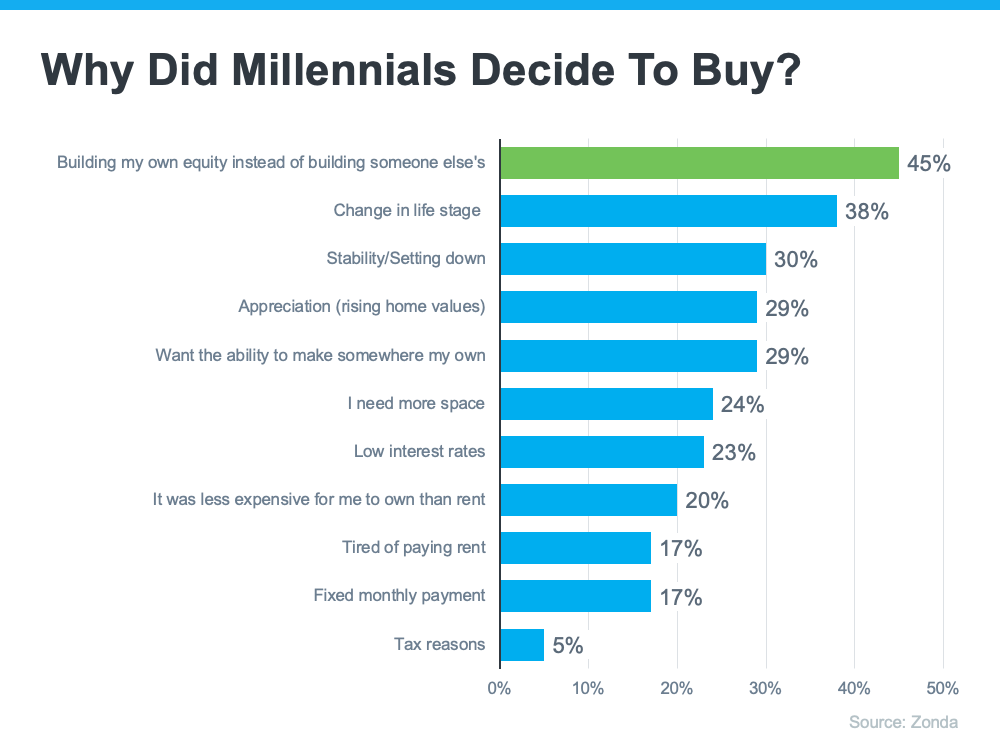
This graph shows why millennials are buying homes according to Zondaβs 6th annual millennial survey. The top reasons include building equity, a change in life stage, wanting stability, rising home values, and wanting to make somewhere truly their own. Hereβs a look at each in more detail.
Building equity β Homeownership is a long-term investment that allows you to build wealth, increase your net worth, and become more financially stable. Beyond that, the alternative to owning a home is typically renting. With the way rents have risen so dramatically over time, it may make sense to build your own equity instead of the equity of the person youβre renting from.
A change in life stage β As a millennial, youβre reaching your prime homebuying years. That means you may be at the point where you need more space or a different location.
Stability or settling down β This could mean establishing your career or just generally deciding more concretely what you want your life to look and feel like. As that idea becomes clearer, you may want to establish that lifestyle in a particular place and put down roots.
Rising home values β By purchasing a home, you own an asset that traditionally increases in value over time. That can mean your home will have a higher resale value if you decide to move again.
Wanting to make somewhere βmineβ β Owning a home gives a sense of freedom because you can customize it however you want, make updates as you see fit, and be yourself in a place thatβs solely your own.
There are plenty of great reasons why millennials are buying homes today. If youβve thought about becoming a homeowner and any of these reasons resonate with you too, letβs connect to explore your options.
For self-employed individuals, buying a home often looks different. Because of document requirements, traditional mortgage loans may not be the ideal solution for everyone, especially for self-employed individuals or those with unconventional income sources. This is where bank statement mortgage loans come into the picture. Unlike traditional mortgages that rely heavily on W-2 forms and tax returns, bank statement loans offer a flexible and alternative financing option that considers a borrower's bank statements as proof of income. Hereβs some details of bank statement mortgage loans and why they can be a great option for certain borrowers.
Understanding Bank Statement Mortgage Loans
Eligibility Criteria
Bank statement mortgage loans are designed to assist self-employed individuals, freelancers, business owners, and other professionals who may not have a traditional salary structure or stable income documentation. The eligibility requirements may vary between lenders, but typically include a minimum credit score, a specific number of bank statements, and a certain minimum deposit amount.
Income Verification
Instead of relying on tax returns or pay stubs, bank statement mortgage loans utilize bank statements to verify income. Typically, lenders will request the borrower's personal and/or business bank statements for the past 12 to 24 months. The statements provide evidence of cash flow, which is used to determine the borrower's ability to repay the loan.
Loan Structure and Terms
Bank statement mortgage loans typically offer both fixed-rate and adjustable-rate options, similar to traditional mortgages. However, borrowers may encounter slightly higher interest rates or additional fees compared to conventional loans due to the increased risk involved. Loan terms may vary, but generally range from 15 to 30 years.
Benefits of Bank Statement Mortgage Loans
Flexibility for Self-Employed Individuals
Self-employed individuals often face challenges when applying for traditional mortgages due to the complexities of documenting their income. Bank statement loans provide a more inclusive option by considering the actual cash flow from their business or personal accounts, enabling them to qualify for a mortgage based on their true financial situation.
Simplified Documentation Process
Compared to traditional mortgages that require extensive paperwork, bank statement loans streamline the documentation process. Applicants can avoid the hassle of gathering tax returns, W-2 forms, and other income-related documents. Instead, they only need to provide their bank statements, simplifying the application and approval process.
Access to Financing for Non-Conventional Income Sources
Bank statement mortgage loans cater to individuals who generate income from diverse sources, such as investments, rental properties, freelance work, or consulting services. By considering these alternative income streams, borrowers who may not fit the mold of traditional employment can still secure a mortgage.
With uncertainty in the economy and astronomically rising inflation, itβs no wonder so many are turning to homeownership to create stability. Owning your own home has major benefits for bringing stability to your present life, as well as to your future. There are numerous benefits to owning your own home. Below we are specifically diving into three major financial benefits of homeownership.
One of the most significant advantages of owning a home is the consistency of your monthly payments. Unlike renting, where your landlord can raise your rent at any time, your mortgage payment will remain the same for the life of your loan. This predictability allows you to plan your budget accordingly and gives you peace of mind, knowing that you will not be hit with unexpected expenses.
Owning a home can be a powerful tool for building your net worth. When you make a mortgage payment, a portion of that payment goes towards paying down the principal balance of your loan. This equity builds up over time, and you can use it to your advantage in various ways. For example, you can use your home equity to take out a home equity loan or line of credit to pay for home renovations, college tuition, or to consolidate debt. Alternatively, you can use your equity to help fund your retirement or as a down payment on your next home.
Historically, homes have appreciated in value over time, making homeownership an excellent long-term investment. While there are no guarantees in the housing market, the National Association of Realtors reports that the median home price in the U.S. has steadily increased over the last 50 years, despite occasional dips and market corrections. This appreciation can be an excellent source of wealth for homeowners who are looking to sell their homes or use their equity for other investments.
In conclusion, homeownership is a sound financial decision that offers numerous benefits. Not only can it provide you with consistent payments, but it can also help you build your net worth and appreciate in value over time. As a mortgage lender, I encourage anyone who is considering buying a home to explore their options and see how homeownership can help them achieve their financial goals.
If youβre planning to buy a home, an inspection is an important step in the process. It assesses the condition of the home before you finalize the transaction. Itβs also a different step in the process from an appraisal, which is a professional evaluation of the market value of the home youβd like to buy. In most cases, an appraisal is ordered by the lender to confirm or verify the value of the home prior to lending a buyer money for the purchase. Hereβs the breakdown of each one and why theyβre both important when buying a home.
Hereβs the key difference between an inspection and an appraisal. Bankrate says:
βIn short, while an appraisal helps you understand a homeβs value, inspections help you understand a homeβs condition.β
The home inspection is a way to determine the current state, safety, and condition of the home before you finalize the sale. If anything is questionable in the inspection process β like the age of the roof, the state of the HVAC system, or just about anything else β you as a buyer have the option to discuss and negotiate any potential issues or repairs with the seller before the transaction is final. Your real estate agent is a key expert to help you through this part of the process.
The National Association of Realtors (NAR) explains:
βA home purchase is typically the largest investment someone will make. Protect yourself by getting your investment appraised! An appraiser will observe the property, analyze the data, and report their findings to their client. For the typical home purchase transaction, the lender usually orders the appraisal to assist in the lenderβs decision to provide funds for a mortgage.β
When you apply for a mortgage, an unbiased appraisal (which is required by the lender) is the best way to confirm the value of the home based on the sale price. Regardless of what youβre willing to pay for a house, if youβll be using a mortgage to fund your purchase, the appraisal will help make sure the bank doesnβt loan you more than what the home is worth.
This is especially critical in todayβs sellersβ market where low inventory is driving an increase in bidding wars, which can push home prices upward. When sellers are in a strong position like this, they tend to believe they can set whatever price they want for their house under the assumption that competing buyers will be willing to pay more.
However, the lender will only allow the buyer to borrow based on the value of the home. This is what helps keep home prices in check. If thereβs ever any confusion or discrepancy between the appraisal and the sale price, your trusted real estate professional will help you navigate any additional negotiations in the buying process.
The inspection and the appraisal are critical steps when buying a home, and you donβt need to manage them by yourself. Letβs connect today so you have the expert guidance you need to navigate the entire homebuying process.
Major changes are coming to Floridaβs very popular Hometown Heroes Program, thanks to a new bill passed by the Florida Legislature.
On March 29th, Governor Desantis signed Senate Bill 102, called the Live Local Act, which, among many other things, expanded the eligibility of the Florida Hometown Heroes down payment program.
Previously, the Florida Hometown Heroes Program was only available to people in certain professions, considered βfront-line workersβ. This included police officers, firefighters, certain medical professionals, among other professions. Now, it widens eligibility from career-based assistance to income-based assistance.
The program now offers down payment assistance in the form of a 0%, non-amortizing, 30-year deferred second mortgage. Which essentially means it is added to the back-end of a personβs mortgage. A person can receive up to 5% of the purchase price, capped at $35,000, to assist in the down payment and closing costs of the loan. Previously, the assistance was capped at $25,000.
To qualify for the program, borrowers must meet certain criteria. Loans are made available to persons or families whose household incomes do not exceed 150 percent of the state median income or local median income, whichever is greater. Borrowers must also be seeking to purchase a home as their primary residence, be first-time homebuyers and Florida residents, and employed full-time by a Florida-based employer. Documentation of full-time employment, or full-time status for self-employed individuals, of 35 hours or more per week is required. However, the requirement to be a first-time homebuyer does not apply to active duty service members of a branch of the armed forces or the Florida National Guard.
Additionally, the Florida General Assembly appropriated another $100 million towards funding the program.
The new changes to the Florida Hometown Hero Program, which go into effect July 1, 2023, is a significant step towards making homeownership more accessible for working Floridians. By reducing the barriers of down payment and closing costs, this program empowers individuals and families to attain long-term housing and financial security.
If you are a working Floridian aspiring to own a home, the Florida Hometown Hero Program may be the right opportunity for you. Contact our team today to learn more and take the first step towards realizing your dream of homeownership.
Improving your credit score can seem like a daunting task, especially if you need to do it fast. A higher credit score can open doors to better loan terms, lower interest rates, and improved financial opportunities. In this blog post, we'll explore three tips to improve your credit score quickly and three more to maintain a good credit score over time.
For fast improvement:
Tip #1 - Raise credit limits
One way to improve your credit score quickly is to ask your credit card issuer to increase your credit limit. When you raise your credit limit, your credit utilization ratio (the percentage of your available credit that you're using) may decrease, and this can have a positive impact on your credit score. It's important to note that you should not increase your spending just because your limit has increased. Instead, continue to spend responsibly and pay off your balances on time.
Tip #2 - Ask to be added as an authorized user on an account
Becoming an authorized user on someone else's credit card account can help improve your credit score. When you're added as an authorized user, the account's payment history and credit limit are factored into your credit report. Ideally, you should ask someone with a long, positive credit history and low credit utilization to add you as an authorized user. Keep in mind that you'll also inherit any negative information associated with the account, so choose wisely.
Tips #3 - Pay credit card balances strategically
Paying down your credit card balances can boost your credit score quickly. Focus on the cards with the highest utilization rates first, as this will have the most significant impact on your score. If possible, pay off the entire balance, but even making a substantial payment can make a difference. Also, consider making multiple payments throughout the month to keep your balances low and improve your credit utilization ratio.
To maintain a good credit score:
Tip #1 - Pay all payments on time
Your payment history is a crucial factor in determining your credit score. Make sure to pay all your bills on time, including credit cards, loans, utilities, and any other recurring expenses. Set up automatic payments or payment reminders to ensure you don't miss any deadlines.
Tip #2 - Dispute credit report errors
Mistakes can happen, and your credit report may contain errors that negatively impact your credit score. It's essential to review your credit report regularly and dispute any inaccuracies you find. Contact the credit bureau and the creditor to correct the information, providing documentation to support your claim if necessary. Once the errors are corrected, your credit score should improve.
Tips #3 - Have a mix of credit types
Lenders like to see that you can handle different types of credit responsibly. A diverse credit portfolio, including revolving credit (credit cards) and installment loans (mortgages, auto loans, student loans), can help improve your credit score. However, it's crucial not to take on new debt just for the sake of diversifying your credit β only open new accounts when necessary and be mindful of your overall debt levels.
Improving and maintaining a good credit score is essential for your financial health. By following these tips, you can boost your credit score quickly and keep it strong over time. Remember that building and maintaining credit is a marathon, not a sprint β stay disciplined and committed to responsible financial habits, and you'll reap the benefits in the long run.
If you are a veteran and served this country, first off thank you for your service! Youβve earned the benefit of having access to Veterans loans, also called VA loans, to refinance or to buy a home.
The VA home loan offers unbeatable benefits for veterans. It is backed by the U.S. Department of Veteran Affairs and is designed to help active military personnel, veterans and certain other groups become homeowners at an affordable cost.
Weβre going to go through the benefits. But hereβs the key important facts: The VA loan asks for no down payment. It requires no mortgage insurance and has more lenient rules about qualifying.
Benefit #1: No Down Payment
Most home loan programs require that you make at least a small down payment to buy a home. The VA home loan is an exception. Rather than paying 5%, 10%, 20% or more for the homeβs purchase price, the VA home loan allows you to finance 100% of the home.
Benefit #2: No Mortgage Insurance
Typically, you are require to pay PMI, or Private Mortgage Insurance, if your down payment is less than 20%.
PMI protects the lender if you default on your loan. VA loans require neither a down payment or mortgage insurance. That makes this VA back mortgage very affordable upfront, and less expensive monthly.
Benefit #3: Government Guarantee
That means the federal government guarantees to lenders that a portion of the loan will be repaid to the lender even if youβre unable to make monthly payments for any reason. Thereβs a reason why the VA loan comes with such great terms and no mortgage insurance.
Benefit #4: Variety of VA Mortgages
With Vas, you have flexibility. You can use your VA loan to buy a house, a condo, a new home, a manufactured home, a duplex and other properties.
You also have the option to use your VA loan to refinance your existing mortgage, make repairs or improvements on your home or make your home more energy efficient.
Benefit #5: Easier to Qualify For
Like all mortgage types, the VA home loan requires specific documentation, an acceptable credit history and sufficient income to make your monthly payments. But as compared to other loan programs, the VA loan guidelines tend to be a little more flexible. Again, a special benefit for military members.
Benefit #6: Closing Costs are Lower
The VA limits the closing costs that lenders can charge to VA loan applicants. What this means for you is that buying a home with a VA is less expensive up front, and youβll be charged less fees. Often times, people use the money saved for decorating, furniture, moving costs, home improvements or anything else.
Benefit #7: VA Loans are Assumable
This one is not often as well known, but it could be a huge deal when selling your home. If a loan is assumable, it means you can transfer your VA loan to a future homebuyer if that person is also VA eligible. Itβs a unique and huge benefit when you go to sell your home in the future.
If your home loan today has a low rate and market rates rise in the future, the assumption feature of your VA home loan becomes even more valuable.
For the 7th year in a row, millennial homebuyers clocked in as being the number one generation for buying homes. According to some recent data, 43 percent of homebuyers in 2022 were millennial, an increase from 37 percent the previous year. And of the total first time home buyer home-purchases, 72 percent of them were millennials.
Yet, millennials also seem to be stepping into home buying at an older age than previous generations. The average first time homebuyer last year was 36 years old. And only 49 percent of millennials actually own their home. This means that over half of millennials are still renters!
This shouldnβt come as a surprise though. The millennial generation grew up during the economic meltdown of 2008, and graduated or entered adulthood in the great recession. For a majority of their lives, there has been some sort of economic turmoil or financial hardship. Reasonably, any homebuyer would pause when given these facts.
Finances also certainly account for the hesitation. Millennials hold record levels of debt. Though most millennials have decent income, they do not have decent savings.
Letβs dive into the top questions and obstacles we see when discussing homeownership with millennials.
As stated, millennials as an aggregate are earning decent incomes. However, most are still living paycheck to paycheck. Meaning, they are unable to make headway in terms of saving. The biggest factor to this is the heavy load of debt most millennials carry.
For millennial home buyers, the most significant obstacle is usually student loans. Over 44 million Americans are still struggling to pay off the debt of over $1.6 trillion. As of 2019, the average graduate has over $35,000 in student loan debt.
This doesnβt even begin to cover typical car debt and credit card debt that many have on their credit report as well.
Tip - Student loan debt is now calculated differently
With student loan repayment still on pause nation-wide, there are different rules for how mortgage lenders must calculate student debt as it related to their debt-to-income ratio.
Previously, lenders had to use the payment reported on a borrowers credit report, or 1 percent of the total loan balance if the loan payment reported at $0. That has changed. The new rule is now to use .5 percent of the student loan balance against their debt to income ratio.
For example, under the previous calculations, if a person has $100,000 in student loan debt, the amount reported would be $1,000. Now, the amount used is $500. That goes a long way when looking at home affordability.
Tip β Talk to a lender first
Talk with a lender about your financial situation in order to get an idea of your goals to hit before buying a home. In some cases, a buyer may just need to pay off a few small things in order to qualify. But each situation is unique.
Tip - Consider downpayment assistance options
There are a plethora of downpayment assistance programs designed to help homebuyers, especially first-time homebuyers, afford their home. There are also loan programs that have lower requirements for how much money must be put down. In some cases, such as with the USDA loan, no money is required to be put down as all.
The standard timeline for buying a home used to be sometime after marriage. That tradition, though not entirely gone, seems to be making its way out the door.
Among first-time buyers, 18 percent were unmarried couples, the highest ever recorded. 17 percent of homebuyers in general were single females and 9 percent single males. Also the highest recorded.
In other changing traditions, Millennials are the first generation to have remote work and travel the most with their job. This means more potential time away from home.
Tip - Deciding on what type of housing makes the most sense is essential for a millennial home buyer.
One of the decisions you will likely face as a potential property owner is whether a condo or a home is a better buying decision based on your current life circumstances and housing needs.
The decision to purchase a condo or townhouse vs. a single-family home is usually one of the top considerations for a millennial home buyer.
Do you travel a lot and donβt have time for property maintenance? Do you have kids who need a yard to play in? Are you likely to want a garden? Are you interested in perks like a pool or a gym you canβt reasonably afford?
Millennials are the most likely to use the internet to find a home, and, interestingly, the most likely to use a real estate agent.
Despite the struggles and setbacks millennials have had in home buying, real estate professionals cannot ignore this population. Since they are the largest group of homebuyers and the most likely to use a real estate professional, real estate agents would be wise to learn about how to best assist this large home buying group.
Todayβs homeowners are sitting on significant equity, even as home price appreciation has eased recently. If youβre a homeowner, your net worth got a boost over the past few years thanks to rising home prices. Hereβs what it means for you, even as the market moderates.
Because of the imbalance between how many homes were for sale and the number of homebuyers in the market over the past few years, home prices appreciated substantially.
And while price appreciation has slowed this year, that doesnβt mean youβve lost all the equity in your home. In fact, the latest Homeowner Equity Insights report from CoreLogic finds the average homeownerβs equity has grown by $34,300 over the past year alone.
And if youβve been in your home longer than that, chances are you have even more equity than you realize.
While thatβs the national number, if you want to know what happened in your area, look at the map below from the Federal Housing Finance Agency (FHFA). It shows on average how much home prices have risen over the past five years, which has been a major driver behind equity growth.
While equity helps increase your overall net worth, it can also help you achieve other goals, like buying your next home. When you sell your current house, the equity youβve built up comes back to you in the sale, and it may be just what you need to cover a large portion β if not all β of the down payment on your next home.
So, if youβve been holding off on selling, it may be time to find out how much equity you have and how it can help fuel your next move.
Homeownership is a long game, and if youβre planning to make a move, the equity youβve gained over time can make a big impact. To find out just how much equity you have in your current home and how you can use it to fuel your next purchase, letβs connect.
Homebuyers struggling to come up with a downpayment just received some welcomed good news. The IRS announced an increase in the gift funds limit for 2023. The new limit for the year per person, per recipient, is $17,000, up from the previous $16,000. This means that a homebuyer can receive up to $17,000 as a gift from a person without having to pay taxes on the gift.
Fortunately, many lenders allow borrowers to make a down payment with gift funds. These funds, commonly known as a down payment gift, come with a few fundamental rules that you should know before accepting them. Hereβs a few considerations to keep in mind when accepting a down payment gift for a mortgage, and how new homeowners should account for these funds.
Loan Program Specifics
Donor requirements vary by mortgage program. Depending on the type of mortgage youβre getting, there are different rules regarding who can provide a down payment gift to you.
For a conventional mortgage loan, the gift money must come from family. Family by blood, marriage, or legal guardianship count. FiancΓ©s and domestic partners also count as family under this loan program.
For FHA Loans, the rules are slightly more lenient. Gifts are allowed from close friends, which could include extended family. Other sources such as employers, labor unions, and charitable organizations could count, depending on the circumstances.
USDA and VA Loans are the most lenient, with allowing for a gift from almost anyone. The one stipulation is that the individual cannot be involved in the purchase transaction.
Other Details
The amount that can be gifted is another question that commonly comes up among borrowers. In most cases, there's no cap on the amount that can be gifted, whether the money is coming from parents, grandparents, or an employer. However, the nature of the mortgage, the borrowerβs credit, and the down payment amount can influence the amount gifted.
Additionally, for most loan programs the gifted funds can be used for a downpayment as well as to cover closing costs.
An Important Note
Itβs worth noting that a mortgage gift cannot be repaid. The gift giver is providing funds to a home buyer with no expectation of being repaid. If the buyer is planning to pay back the funds, that money was loaned, not gifted, and the lender is required to factor that into the debt-to-income ratio.
Donors are also required to submit a gift letter to the lender. Information that should be included in this letter is a statement that the money will not be repaid, the dollar amount, the date of funds transfer, donors relationship to borrower, and contact information.
The lender will also likely require documentation showing the transfer of money for the gift. This could include bank statements of the borrower and donor, proof of wire transfer or check, and possibly a copy of the check.
In conclusion, receiving gift money for a mortgage down payment is a great way to jump-start your financial well-being when saving for homeownership. However, it's important to keep in mind the rules and restrictions surrounding down payment gifts. Itβs always recommended to speak with your lender for information on acceptable donors and how to properly disclose gift funds.
Homebuyers and those who use the FHA loan program just received some much needed good news. Beginning March 20th, the US Department of Housing and Urban Development (HUD) will be reducing the annual mortgage insurance premiums (MIP) on FHA mortgages, which are insured by HUD's Federal Housing Administration.
Currently, FHA mortgage borrowers must pay 1.75% of their loan amount in upfront mortgage insurance costs, and they typically pay an annual premium of 0.85%, which is added to their monthly mortgage payment. However, with the new lower rates, borrowers of new FHA mortgages will pay only 0.55% of their loan amount annually in mortgage insurance costs.
For those who have had difficulty achieving homeownership due to less-than-perfect credit or a lack of resources, FHA mortgages have provided a much-needed opportunity. However, one major drawback of these mortgages has been the relatively high cost of mortgage insurance. But soon, FHA borrowers will be able to benefit from lower annual mortgage insurance rates.
The White House announced this change on Wednesday, stating that the FHA's mortgage insurance fund has more than five times the reserves required by Congress. As a result, HUD Secretary Marcia L. Fudge said in a press release that "we are building on the steps we've taken to make homeownership more affordable, and HUD is acting to ensure people feel comfortable purchasing a home as they build toward their future. As we reduce housing costs for people with FHA mortgages, we continue our work to address longstanding disparities in homeownership."
This reduction in annual MIP is a significant benefit for new FHA mortgage borrowers. The annual MIP is paid as a percentage of the borrower's loan amount, and the amount paid depends on how much the borrower borrowed, their down payment, and the loan term. This reduction in costs will save the average homebuyer with a new FHA mortgage approximately $800 per year.
It is important for all Americans to have access to opportunities such as wealth-building and homeownership. The reduction of annual MIP on FHA mortgages is a step in the right direction to address longstanding disparities in homeownership and make it more accessible to all.
Before you buy a home, itβs important to plan ahead. While most buyers consider how much they need to save for a down payment, many are surprised by the closing costs they have to pay. To ensure you arenβt caught off guard when itβs time to close on your home, you need to understand what closing costs are and how much you should budget for.
People are sometimes surprised by closing costs because they donβt know what they are. According to Bankrate:
βClosing costs are the fees and expenses you must pay before becoming the legal owner of a house, condo or townhome . . . Closing costs vary depending on the purchase price of the home and how itβs being financed . . .β
In other words, your closing costs are a collection of fees and payments involved with your transaction. According to Freddie Mac, while they can vary by location and situation, closing costs typically include:
Government recording costs
Appraisal fees
Credit report fees
Lender origination fees
Title services
Tax service fees
Survey fees
Attorney fees
Underwriting Fees
Understanding what closing costs include is important, but knowing what youβll need to budget to cover them is critical, too. According to the Freddie Mac article mentioned above, the costs to close are typically between 2% and 5% of the total purchase price of your home. With that in mind, hereβs how you can get an idea of what youβll need to cover your closing costs.
Letβs say you find a home you want to purchase for the median price of $366,900. Based on the 2-5% Freddie Mac estimate, your closing fees could be between roughly $7,500 and $18,500.
Keep in mind, if youβre in the market for a home above or below this price range, your closing costs will be higher or lower.
Freddie Mac provides great advice for homebuyers, saying:
βAs you start your homebuying journey, take the time to get a sense of all costs involved β from your down payment to closing costs.β
Work with a team of trusted real estate professionals to understand exactly how much youβll need to budget for closing costs. An agent can help connect you with a lender, and together your expert team can answer any questions you might have.
Itβs important to plan for the fees and payments youβll be responsible for at closing. Letβs connect so I can help you feel confident throughout the process.
Believe it or not, itβs already time to start prepping those tax returns for 2022! This time of year we get many questions regarding what information is needed regarding mortgages to file taxes, as well as what could be a tax deduction.
To get started, youβll need the usuals: W-2s and 1099s, statements for your retirement accounts and assets, and documentation of your education and childcare expenses, among other items. Homeowners will need a handful of mortgage documents as well. Hereβs a quick list of the mortgage documents you may need to file your tax returns:
1098 Form
The 1098 is your mortgage interest statement. It shows how much interest you paid on your mortgage loan for the year. If you choose to write this interest off from your taxable income, youβll use this form to prove how much you paid.
In some cases, you may have multiple 1098s. This might happen if your loan was transferred to a new servicer during the year, in which case youβd then have one from each servicer. Or you could have multiple 1098s if you have multiple loans, such as a HELOC, or multiple properties β like a vacation home or second house. Your mortgage servicer should send you these by the end of January.
Closing statement
If you bought a home in the previous year, your closing statement is important. When you take out a mortgage, you may have the option to buy mortgage points, which is a form of prepaid interest. Each point, which costs 1% of your mortgage amount, can get you about 0.25% off your mortgage rate. Mortgage points are paid at closing and must be paid directly to the lender to qualify you for the deduction. If you chose to do so, you may be able to deduct the points you paid at your closing.
Property tax statement
Your property taxes may also deductible. The amount you paid is usually noted on your 1098 form, but thereβs a chance it might not be β particularly if you chose not to use an escrow account.
Home improvement receipts
In general, home improvements arenβt deductible, but there are some instances when they might be. For example, if your updates were medically related, such as adding a wheelchair ramp, they could be a medical write-off. If they improve your homeβs energy efficiency, like a solar panels, they might also qualify you for a write-off or tax credit.
So what else is deductible?
Interest On The Mortgage For Your Main Home
It doesnβt matter if your home is a traditional house, co-op, apartment, condo, mobile home, or houseboat - many types of property qualify for mortgage interest deductions! One note, the property will not qualify if it doesnβt have basic living accommodations, such as proper sleeping, cooking and bathroom facilities. The property must also be listed as collateral for the loan youβre deducting interest payments from. In some instances, you can also use this deduction if you got a mortgage to buy out an ex spouseβs half of the property in a divorce scenario.
For military members - You can still deduct mortgage interest if you receive a non-taxable housing allowance from the military.
Interest On The Mortgage For A Second Home
Many people are suprised to find out they can receive a tax deduction on a mortgage for a home that is not a primary residence, as long as the second home is listed as collateral for that mortgage. There are some special scenarios and caveats, so be sure you review with a tax professional. If you have more than one second home, you can only deduct the interest for one.
Interest On A Home Equity Loan
A home equity loan, or home equity line of credit, is money borrowed from the equity you have in the home. For the interest you pay on a home equity loan to qualify, the money from the loan has to be used to buy, build or βsubstantially improveβ your home. If the money is used for something else, such as buying a car or paying down credit card debt, the interest isnβt deductible.
As mortgage rates rose last year, activity in the housing market slowed down. And as a result, homes started seeing fewer offers and stayed on the market longer. That meant some homeowners decided to press pause on selling.
Now, however, rates are beginning to come downβand buyers are starting to reenter the market. In fact, the latest data from the Mortgage Bankers Association (MBA) shows mortgage applications increased last week by 7% compared to the week before.
So, if youβve been planning to sell your house but youβre unsure if there will be anyone to buy it, this shift in the market could be your chance. Hereβs what experts are saying about buyers returning to the market as we approach spring.
Mike Fratantoni, SVP and Chief Economist, MBA:
βMortgage rates are now at their lowest level since September 2022, and about a percentage point below the peak mortgage rate last fall. As we enter the beginning of the spring buying season, lower mortgage rates and more homes on the market will help affordability for first-time homebuyers.β
Lawrence Yun, Chief Economist, National Association of Realtors (NAR):
βThe upcoming months should see a return of buyers, as mortgage rates appear to have already peaked and have been coming down since mid-November.β
Thomas LaSalvia, Senior Economist, Moodyβs Analytics:
βWe expect the labor market to remain robust, wages to continue to riseβmaybe not at the pace that they did during the pandemic, but that will open up some opportunity for folks to enter homeownership as interest rates stabilize a bit.β
Sam Khater, Chief Economist, Freddie Mac:
βHomebuyers are waiting for rates to decrease more significantly, and when they do, a strong job market and a large demographic tailwind of Millennial renters will provide support to the purchase market.β
Bottom Line
If youβve been thinking about making a move, nowβs the time to get your house ready to sell. Letβs connect so you can learn about buyer demand in our area the best time to put your house on the market.
Wall Street's Investment in Single-Family Rentals: A Sign for Homebuyers
The housing market is undergoing a shift, and Wall Street has taken notice. Institutional investors have amassed a massive $110 billion to purchase or build single-family rentals, marking the largest amount of investment ever made for acquiring US homes.
This substantial investment is a clear indication of the growth potential in the single-family rental market, which is estimated to be worth $4.4 trillion. The $110 billion is also estimated to represent about 3 percent of single family homes, nation-wide.
If major investors are seeing the opportunity in real estate, everyone else should as well. Now is a great time for individuals to consider buying a home. If Wall Street investors are willing to put in such a significant amount of money, it stands to reason that the market presents an excellent opportunity for families as well.
The downside? If potential homeowners donβt take action, they are likely to have one of these major investors as their landlord down the road. With many homes being bought up and set aside as rental units, housing could become more scarce down the road, making it more difficult for your average family to buy.
Why wait? With so many new down payment assistant programs and grants available this year, itβs the perfect time to step into home ownership.
Buying a home is an exciting journey for any couple, married or not! However, when it comes to co-owning a property, things can get complicated if you're not married. Here are some tips to help you navigate the process smoothly and protect both of your interests.
Have a clear understanding of your financial situation
Before you start house hunting, have an honest conversation about your finances. Decide who will pay what and make sure both of you understand the financial commitment involved in buying a home.
Draw up a co-ownership agreement
A co-ownership agreement is a legal document that outlines the terms and conditions of your ownership. It should include details such as how much each person is contributing to the purchase, how expenses will be split, and what will happen in the event of a separation.
Consider a tenancy in common arrangement
This type of arrangement sets out who owns what percentage, clarifies the couple's financial obligations, and spells out each person's buying and selling restrictions and duties in the event of a split-up.
Title the property carefully
The way the property is titled can have significant legal and financial implications for both parties. It's important to discuss this with a lawyer and make sure the title reflects your intentions and agreement.
Obtain homeowner's insurance
Homeowner's insurance protects your investment in case of damage or loss to the property. Make sure both of your names are listed on the policy.
Have a plan for the future
Discuss what will happen if one person wants to sell the property, or if one person dies. It's important to have a plan in place so that the process is smooth and less stressful for both parties.
Buying a home is an exciting time in a newly married or engaged couple's life, but it can also be a little overwhelming. With so many factors to consider, it's important to be well-prepared and informed. In this blog, we'll share tips and advice to help make the process of buying your first home together as smooth and stress-free as possible. So, let's start this exciting journey together!
Determine your budget
Before you start house hunting, it's important to determine your budget. This includes not only the cost of the house itself, but also the cost of any repairs or upgrades, property taxes, and other expenses. To get a better idea of what you can afford, consider getting pre-approved for a mortgage (see tip #2). You can also use a mortgage calculator to estimate your monthly payments.
Get pre-approved for a mortgage
Getting pre-approved for a mortgage is a crucial step in the home-buying process. By getting pre-approved, you will know what you can afford and can make a more competitive offer when you find the right home. When you're pre-approved, the lender will provide you with a letter that states your borrowing capacity, which you can provide to real estate agents and sellers as evidence that you are a serious buyer.
Decide on a location
The location of your home is an important factor to consider, as it will affect your daily life and your ability to resell the home in the future. Consider your lifestyle and what you're looking for in a neighborhood, such as proximity to work, school, and other amenities. Take the time to research different areas and visit open houses to get a feel for the area.
Make a list of your must-haves
When it comes to buying a home, it's important to have a clear idea of what you want and what you're willing to compromise on. Make a list of your must-haves, such as the number of bedrooms, the size of the yard, and the type of kitchen, and keep this list with you as you search for homes. This will help you focus your search and make the decision-making process easier.
Work with a real estate agent
A real estate agent can be a valuable resource when it comes to buying a home. A good agent can help you find the right home, negotiate a fair price, and guide you through the closing process. Look for an agent with experience and good references, and be open and honest about what you're looking for in a home.
Don't skimp on the home inspection
A home inspection is an important part of the home-buying process, as it can reveal any potential problems with the home that may not be obvious to the naked eye. Don't skimp on the home inspection, as it can save you from buying a home that has serious problems. Be sure to work with a licensed inspector and be present during the inspection so you can ask questions and see any potential issues for yourself.
In the 2023 landscape, there has been much speculation about the state of the real estate market. With all of the changes that have taken place in recent years, it's not surprising that there are questions about what to expect in the coming months. In this blog, we will explore what the market is telling us about the future and what you can expect as a homebuyer or homeowner.
First, it is important to understand that the market is not experiencing a crash. Instead, it is leveling out after a significant increase in the past few years. While there may be a moderate drop in some markets, this is not a cause for alarm. In many markets, the average increase is still expected to be between 3 and 5 percent, and some areas are even seeing steady growth.
Additionally, there is a lack of inventory in many markets, which is contributing to the steady growth. For example, the Denver market has very little inventory, with only 1500 homes available for millions of residents. This is a strong indicator that the market will not crash, as there is still a high demand for homes.
The government and agencies like Fannie Mae and Freddie Mac are also playing a role in stimulating the real estate market. They are focusing on helping first-time homebuyers and people with lower to moderate incomes and credit scores get into homes. To this end, they are changing the rules and offering various programs to make it easier for these demographics to purchase homes.
For those who have been sitting out the market for the past two years, now may be their time. A buyer's market is defined as six months or more of inventory, and we have not seen a true buyer's market since 2012. To reach six months of inventory, we would need 2 million listings nationwide, which we have not seen since 2015. Despite this, there is still a high demand for homes, and interest rates remain low.
The real estate market in 2023 is expected to be stable, with a focus on helping first-time homebuyers and those with lower to moderate incomes and credit scores. While there may be a moderate drop in some markets, this is not a cause for alarm, and the market is expected to continue to grow steadily in the coming months. As always, it is important to do your research and speak with a real estate professional to understand what to expect in your area.
In 2022, Florida Governor Ron DeSantis announced the creation of a new down payment assistance program geared towards helping hometown heroes purchase their first home.
The Florida General Assembly appropriated $100 million towards this new program, which is administered through the Florida Housing department.
The program offers down payment assistance in the form of a 0%, non-amortizing, 30-year deferred second mortgage. Which essentially means it is added to the back-end of a personβs mortgage. A person can receive up to 5% of the purchase price (capped at $25,000) to assist in the down payment and closing costs of the loan.
The down payment assistance can be used on a FHA, VA, USDA, and certain conventional loans, as long as the borrower is a first-time home buyer. The loan must also be a 30-year term at a fixed rate.
There are certain income limits, based on the county the borrower is purchasing in, as well as limits to how much a person can borrow under the program. For Manatee and Sarasota counties, the limits are as follows:
Income limit: $129,450
FHA & USDA: $420,680
VA and Conventional: $647,200
There are almost 50 occupations that are eligible for the program. See below for a list of the eligible occupations.
If you're a new homeowner in Florida, it's important to remember that the deadline to file for the Homestead Exemption is fast approaching. March 1st is the last day to apply for this valuable tax break, which can save you thousands of dollars on your property taxes each year.
The Homestead Exemption is a state-mandated program that provides a property tax reduction for residents who own and live in their homes. To qualify, you must be a permanent Florida resident and the property must be your primary residence as of January 1st of the current year.
The exemption applies to the first $50,000 of the assessed value of your property and can reduce your property taxes by hundreds or even thousands of dollars each year. Additionally, if you are a senior citizen, disabled person, or a veteran, you may qualify for additional exemptions.
Filing for the Homestead Exemption is easy and can be done online, by mail, or in person at your local property appraiser's office. All you need to provide is proof of Florida residency, such as a driver's license or utility bill, and proof of ownership, such as a copy of your recorded deed.
Don't miss out on this valuable tax break! Make sure to file for the Homestead Exemption before the March 1st deadline. Not only will it save you money on your property taxes, but it will also help to keep your property taxes low in the future.
βββββββββββββββββββββββββββββββββββββββββββ
Si es propietario de una vivienda nueva en Florida, es importante recordar que se acerca rΓ‘pidamente la fecha lΓmite para solicitar la exenciΓ³n de vivienda. El 1 de marzo es el ΓΊltimo dΓa para solicitar esta valiosa exenciΓ³n fiscal, que puede ahorrarle miles de dΓ³lares en sus impuestos sobre la propiedad cada aΓ±o. La ExenciΓ³n de Homestead es un programa exigido por el estado que proporciona una reducciΓ³n de impuestos a la propiedad para los residentes que son dueΓ±os y viven en sus hogares. Para calificar, debe ser residente permanente de Florida y la propiedad debe ser su residencia principal a partir del 1 de enero del aΓ±o en curso. La exenciΓ³n se aplica a los primeros $50,000 del valor de tasaciΓ³n de su propiedad y puede reducir sus impuestos sobre la propiedad en cientos o incluso miles de dΓ³lares cada aΓ±o. AdemΓ‘s, si es una persona de la tercera edad, una persona discapacitada o un veterano, puede calificar para exenciones adicionales. La presentaciΓ³n de la ExenciΓ³n de Homestead es fΓ‘cil y se puede hacer en lΓnea, por correo o en persona en la oficina local del tasador de propiedades. Todo lo que necesita proporcionar es una prueba de residencia en Florida, como una licencia de conducir o una factura de servicios pΓΊblicos, y una prueba de propiedad, como una copia de su escritura registrada. Β‘No se pierda esta valiosa exenciΓ³n fiscal! AsegΓΊrese de solicitar la exenciΓ³n de Homestead antes de la fecha lΓmite del 1 de marzo. No solo le ahorrarΓ‘ dinero en sus impuestos sobre la propiedad, sino que tambiΓ©n ayudarΓ‘ a mantener bajos sus impuestos sobre la propiedad en el futuro. Homebuyers with NO credit score are about to receive a huge relief. Beginning January 10th, Novus Home Mortgage rolled out a new loan program that creates opportunity for those who wouldnβt be able to qualify for a mortgage traditionally.
So, what exactly are no credit score loans and how do they work?
No credit score loans are mortgage programs that do not require a traditional credit score for qualification. Instead of relying on credit scores, lenders will use alternative methods to evaluate the borrower's creditworthiness. This can include things like rent and utility payment history, employment history, and bank account history.
One of the main benefits of no credit score loans is that they offer a way for those who don't have a credit score or who have a low credit score to still qualify for a mortgage. This can be especially useful for first-time homebuyers or those who have a limited credit history. It can also be a good option for those who have had financial challenges in the past and have a low credit score as a result.
No credit score loans do come with some additional requirements, however. For example, borrowers may need to have a higher down payment or a higher income in order to qualify. They may also need to have a co-signer or provide additional documentation to demonstrate their creditworthiness.
Despite these additional requirements, no credit score loans can be a great option for those who are otherwise unable to qualify for a traditional mortgage. If you're interested in this type of loan, it's important to do your research and find a lender who is experienced in working with no credit score borrowers. With the right lender and a bit of planning, it's possible to secure a no credit score loan and achieve your homeownership dreams.
βββββββββββββββββββββββββββββββββββββββββββ
Los compradores de vivienda SIN puntaje de crΓ©dito estΓ‘n a punto de recibir un gran alivio. A partir del 10 de enero, Novus Home Mortgage lanzΓ³ un nuevo programa de prΓ©stamos que crea oportunidades para aquellos que tradicionalmente no podrΓan calificar para una hipoteca. Entonces, ΒΏquΓ© son exactamente los prΓ©stamos sin puntaje de crΓ©dito y cΓ³mo funcionan? Los prΓ©stamos sin puntaje crediticio son programas hipotecarios que no requieren un puntaje crediticio tradicional para calificar. En lugar de confiar en los puntajes de crΓ©dito, los prestamistas utilizarΓ‘n mΓ©todos alternativos para evaluar la solvencia del prestatario. Esto puede incluir cosas como el historial de pago de alquiler y servicios pΓΊblicos, historial de empleo e historial de cuenta bancaria. Uno de los principales beneficios de los prΓ©stamos sin puntaje crediticio es que ofrecen una manera para que aquellos que no tienen puntaje crediticio o que tienen un puntaje crediticio bajo califiquen para una hipoteca. Esto puede ser especialmente ΓΊtil para los compradores de vivienda por primera vez o aquellos que tienen un historial crediticio limitado. TambiΓ©n puede ser una buena opciΓ³n para aquellos que han tenido problemas financieros en el pasado y, como resultado, tienen un puntaje crediticio bajo. Sin embargo, los prΓ©stamos sin puntaje de crΓ©dito vienen con algunos requisitos adicionales. Por ejemplo, los prestatarios pueden necesitar un pago inicial mΓ‘s alto o un ingreso mΓ‘s alto para calificar. Es posible que tambiΓ©n necesiten tener un codeudor o proporcionar documentaciΓ³n adicional para demostrar su solvencia. A pesar de estos requisitos adicionales, los prΓ©stamos sin puntaje de crΓ©dito pueden ser una excelente opciΓ³n para aquellos que de otro modo no podrΓan calificar para una hipoteca tradicional. Si estΓ‘ interesado en este tipo de prΓ©stamo, es importante que investigue y encuentre un prestamista que tenga experiencia en trabajar con prestatarios sin calificaciΓ³n crediticia. Con el prestamista adecuado y un poco de planificaciΓ³n, es posible obtener un prΓ©stamo sin calificaciΓ³n crediticia y lograr sus sueΓ±os de ser propietario de una vivienda. Are you ready to take advantage of a new mortgage application program that offers speed and savings to YOU? Introducing the Platinum Pre-Approval Program β an exciting new offer from The Galli Team that will be the key to unlocking a faster mortgage application process.
The Platinum Pre-Approval Program gives applicants an expedited approval process and a major incentive β a $100 lender credit β when they submit all of their documents and complete their loan application within 48 hours of downloading the application.
The $100 lender credit is a major incentive for borrowers to take advantage of the Platinum Pre-Approval Program. Not only does it give borrowers a chance to get an expedited approval process, but it also provides them with a financial incentive that can be put towards closing costs associated with the loan.
Are you ready to step into homeownership this year? Click the βapply nowβ button above to get started!
βββββββββββββββββββββββββββββββββββββββββββ
ΒΏEstΓ‘ listo para aprovechar un nuevo programa de solicitud de hipoteca que le ofrece rapidez y ahorro? Presentamos el Programa de preaprobaciΓ³n Platinum: una nueva y emocionante oferta del equipo de Galli que serΓ‘ la clave para desbloquear un proceso de solicitud de hipoteca mΓ‘s rΓ‘pido. El Programa de preaprobaciΓ³n Platinum brindarΓ‘ a los solicitantes un proceso de aprobaciΓ³n acelerado y un gran incentivo, un crΓ©dito de prestamista de $100, cuando presenten todos sus documentos y completen su solicitud de prΓ©stamo dentro de las 48 horas posteriores a la descarga de la solicitud. El crΓ©dito del prestamista de $100 es un gran incentivo para que los prestatarios aprovechen el programa de aprobaciΓ³n previa Platinum. No solo brinda a los prestatarios la oportunidad de obtener un proceso de aprobaciΓ³n acelerado, sino que tambiΓ©n les brinda un incentivo financiero que puede destinarse a los costos de cierre asociados con el prΓ©stamo. ΒΏEstΓ‘ listo para convertirse en propietario de una vivienda este aΓ±o? Β‘Haga clic en el botΓ³n "aplicar ahora" arriba para comenzar! A USDA loan is a type of home loan offered by the United States Department of Agriculture (USDA). It is designed to help low- to moderate-income individuals and families buy homes in rural areas, particularly in areas where traditional financing may not be available.
One of the main benefits of a USDA loan is that it is 100 percent financing and does not require a down payment for a USDA loan, making it a great option for those who may not have a lot of savings or are unable to come up with a down payment for a traditional mortgage.
Another advantage of a USDA loan is that it often comes with lower mortgage rates compared to other types of home loans. This is because the USDA guarantees the loan, which reduces the risk for the lender and allows them to offer lower rates to borrowers.
However, there are some limitations to a USDA loan. For example, the property being purchased must be located in a rural area, as defined by the USDA. You can check on the eligibility of a property here. There are also limits to income, which is area based. You can find information on income eligibility here.
Click the βapply todayβ button above to start your application!
ββββββββββββββββββββββββββββββββββββββββββββββββ--
Un prΓ©stamo USDA es un tipo de prΓ©stamo hipotecario ofrecido por el Departamento de Agricultura de los Estados Unidos (USDA). EstΓ‘ diseΓ±ado para ayudar a personas y familias de ingresos bajos a moderados a comprar casas en Γ‘reas rurales, particularmente en Γ‘reas donde el financiamiento tradicional puede no estar disponible. Uno de los principales beneficios de un prΓ©stamo del USDA es que es un financiamiento del 100 por ciento y no requiere un pago inicial para un prΓ©stamo del USDA, lo que lo convierte en una excelente opciΓ³n para aquellos que no tienen muchos ahorros o no pueden encontrar un pago inicial para una hipoteca tradicional. Otra ventaja de un prΓ©stamo del USDA es que a menudo viene con tasas hipotecarias mΓ‘s bajas en comparaciΓ³n con otros tipos de prΓ©stamos hipotecarios. Esto se debe a que el USDA garantiza el prΓ©stamo, lo que reduce el riesgo para el prestamista y les permite ofrecer tasas mΓ‘s bajas a los prestatarios. Sin embargo, existen algunas limitaciones para un prΓ©stamo del USDA. Por ejemplo, la propiedad que se compra debe estar ubicada en un Γ‘rea rural, segΓΊn lo define el USDA. Puede verificar la elegibilidad de una propiedad aquΓ. TambiΓ©n hay lΓmites para los ingresos, que se basan en el Γ‘rea. Puede encontrar informaciΓ³n sobre la elegibilidad de ingresos aquΓ. Β‘Haga clic en el botΓ³n "aplicar hoy" arriba para comenzar su aplicaciΓ³n! Are you considering purchasing a home? Before stepping into home buying, youβll want to make sure you have the best tools in your tool belt to give you the edge over competitors. With a Certified Credit Pre-Approval from Novus Home Mortgage, you can be sure you have the financial backing you need to make your purchase.
A Certified Credit Pre-Approval, or CCA, is the strongest and most thorough type of pre-approval available. The lender reviews all of the buyerβs financial information before issuing the CCA with the loan amount and terms. This process is more in-depth than a regular pre-approval, which is based solely on the buyerβs credit score and a few income documents.
An offer on a home with a CCA is, essentially, as good as cash. This is because the buyer will already be fully underwritten before they put an offer in on a home. CCAs are subject to an appraisal, but a majority of the heavy lifting is already completed. For this reason, CCAs allow for a shorter closing timeline if needed.
Having a CCA provides buyers with a competitive edge when bidding on homes. Sellers can be more confident that the buyer is serious and has the financial means to close the deal.
If youβre thinking of buying a home, reach out to our team to explore the option of a Certified Credit Pre-Approval to prepare you for your homebuying journey.
βββββββββββββββββββββββββββββββββ
ΒΏEstΓ‘ considerando comprar una casa? Antes de comenzar a comprar una casa, querrΓ‘ asegurarse de tener las mejores herramientas en su cinturΓ³n de herramientas para darle una ventaja sobre la competencia. Con una preaprobaciΓ³n de crΓ©dito certificada de Novus Home Mortgage, puede estar seguro de que tiene el respaldo financiero que necesita para realizar su compra. Una preaprobaciΓ³n de crΓ©dito certificada, o CCA, es el tipo de preaprobaciΓ³n mΓ‘s sΓ³lido y completo disponible. El prestamista revisa toda la informaciΓ³n financiera del comprador antes de emitir la CCA con el monto y los tΓ©rminos del prΓ©stamo. Este proceso es mΓ‘s profundo que una preaprobaciΓ³n regular, que se basa ΓΊnicamente en el puntaje de crΓ©dito del comprador y algunos documentos de ingresos. Una oferta por una casa con CCA es, esencialmente, tan buena como el efectivo. Esto se debe a que el comprador ya estarΓ‘ completamente respaldado antes de presentar una oferta por una casa. Los CCA estΓ‘n sujetos a una evaluaciΓ³n, pero la mayorΓa del trabajo pesado ya se ha completado. Por esta razΓ³n, los CCA permiten un cronograma de cierre mΓ‘s corto si es necesario. Tener un CCA proporciona a los compradores una ventaja competitiva al ofertar por viviendas. Los vendedores pueden estar mΓ‘s seguros de que el comprador es serio y tiene los medios financieros para cerrar el trato. Si estΓ‘ pensando en comprar una casa, comunΓquese con nuestro equipo para explorar la opciΓ³n de una aprobaciΓ³n previa de crΓ©dito certificada para prepararlo para su viaje de compra de vivienda. Are you a first-time homebuyer in Rhode Island? Are you looking for an affordable way to purchase your first home? If so, you may want to consider taking advantage of Rhode Islandβs 10kDPA program. The 10kDPA program provides eligible first-time homebuyers with up to $10,000 in down payment and closing cost assistance to help them purchase their first home.
The 10kDPA program is administered by the Rhode Island Housing Authority. In order to be eligible for the program, applicants must meet certain criteria. They must have an income at or below 80 percent of the area median income, they must be first-time homebuyers, have a minimum credit score of 660, and they must be purchasing a home in Rhode Island. Additionally, applicants must complete an approved homebuyer education program and obtain an approved mortgage loan.
A first-time homebuyer, in this case, is someone who has not owned a home in the last three years. Or owned a home with a previous spouse, but have since divorced.
Once applicants have met the eligibility requirements, they can apply for the 10kDPA program. The program provides up to $10,000 in assistance, which can be used for both down payment and closing costs. This assistance is provided in the form of a zero-interest, deferred loan, which means that you donβt have to pay back the loan until you sell, refinance, or pay off your mortgage.
In addition to the 10kDPA program, Rhode Island Housing also offers a variety of other programs to help first-time homebuyers in the state. These programs include grants and loans for down payment assistance, as well as education and counseling services to help homebuyers understand the homebuying process.
If you are a first-time homebuyer in Rhode Island and are looking for an affordable way to purchase your first home, the 10kDPA program may be a great option for you. Reach out to our team to learn more about the program and to see if you qualify.
βββββββββββββββββββββββββββββββββ
ΒΏEs usted un comprador de vivienda por primera vez en Rhode Island? ΒΏEstΓ‘ buscando una forma econΓ³mica de comprar su primera casa? Si es asΓ, puede considerar aprovechar el programa 10kDPA de Rhode Island. El programa 10kDPA brinda a los compradores de vivienda primerizos elegibles hasta $10,000 en asistencia para el pago inicial y los costos de cierre para ayudarlos a comprar su primera vivienda. El programa 10kDPA es administrado por la Autoridad de Vivienda de Rhode Island. Para ser elegible para el programa, los solicitantes deben cumplir con ciertos criterios. Deben tener un ingreso igual o inferior al 80 por ciento del ingreso medio del Γ‘rea, deben ser compradores de vivienda por primera vez, tener un puntaje de crΓ©dito mΓnimo de 660 y deben comprar una casa en Rhode Island. AdemΓ‘s, los solicitantes deben completar un programa de educaciΓ³n para compradores de vivienda aprobado y obtener un prΓ©stamo hipotecario aprobado. Un comprador de vivienda por primera vez, en este caso, es alguien que no ha sido propietario de una vivienda en los ΓΊltimos tres aΓ±os. O era dueΓ±o de una casa con un cΓ³nyuge anterior, pero desde entonces se divorciΓ³. Una vez que los solicitantes hayan cumplido con los requisitos de elegibilidad, pueden solicitar el programa 10kDPA. El programa brinda hasta $10,000 en asistencia, que se puede usar tanto para el pago inicial como para los costos de cierre. Esta asistencia se brinda en forma de un prΓ©stamo diferido sin interΓ©s, lo que significa que no tiene que pagar el prΓ©stamo hasta que venda, refinancie o pague su hipoteca. AdemΓ‘s del programa 10kDPA, Rhode Island Housing tambiΓ©n ofrece una variedad de otros programas para ayudar a los compradores de vivienda por primera vez en el estado. Estos programas incluyen subvenciones y prΓ©stamos para asistencia con el pago inicial, asΓ como servicios de educaciΓ³n y asesoramiento para ayudar a los compradores de vivienda a comprender el proceso de compra. Si es la primera vez que compra una vivienda en Rhode Island y estΓ‘ buscando una forma econΓ³mica de comprar su primera vivienda, el programa 10kDPA puede ser una gran opciΓ³n para usted. ComunΓquese con nuestro equipo para obtener mΓ‘s informaciΓ³n sobre el programa y ver si califica. The Federal Housing Finance Agency (FHFA) recently announced the new conforming loan limits for 2023. This is great news for potential home buyers and current homeowners looking to refinance, as it increases the amount of money they can borrow and use to buy or refinance a home.
The conforming loan limit for a one-unit home in most areas is now $765,600, up from $647,200 in 2022. This is a 18% increase, the largest since 2006. The conforming loan limit is the maximum loan amount that can be purchased or backed by Fannie Mae and Freddie Mac, the two government-sponsored enterprises that provide the bulk of mortgage financing in the United States.
This increase in the conforming loan limit will allow more potential home buyers to qualify for mortgages that are backed by Fannie Mae and Freddie Mac. This will make it easier for buyers to purchase a larger, more expensive home and still benefit from the lower interest rates that come with Fannie Mae and Freddie Mac loans.
Current homeowners looking to refinance their mortgage can also benefit from the increase in the conforming loan limit. The higher loan limits make it easier for homeowners to qualify for refinancing and take advantage of the historically low interest rates.
The increase in the conforming loan limit is one of many moves the FHFA has made in recent years to make home ownership more accessible to Americans. From increasing the credit score thresholds for Fannie Mae and Freddie Mac loans to introducing new programs that make it easier for borrowers to refinance their mortgages, the FHFA has been working to ensure that more Americans can become homeowners.
The new conforming loan limits are a welcome development for potential home buyers and current homeowners looking to refinance their mortgage.
As welcomed news for first-time homebuyers, it was recently announced that beginning in 2023, the FHLB Homebuyer Grant will increase to $10,000, making it even easier for aspiring homeowners to purchase a home. This increase in funding will help more people achieve the dream of homeownership.
As a potential first-time homebuyer, you may be eligible for the Federal Home Loan Bank (FHLB) Homebuyer Grant. This grant will provide up to $10,000 to assist you with the purchase of a home. The FHLB Homebuyer Grant is available in all 50 states, the District of Columbia, and the U.S. Virgin Islands.
The FHLB Homebuyer Grant is intended to help first-time homebuyers with low to moderate incomes complete the purchase of a home. The grant can be used for down payment assistance, closing costs, or other related expenses. It can also be used to purchase a home in a designated rural area or a home located in a designated low- to moderate-income census tract.
In order to qualify for the FHLB Homebuyer Grant, you must meet certain criteria. You must be a first-time homebuyer, have a valid Social Security number, and have an eligible source of income. You must also have a credit score of at least 620 and meet income limits based on the size of your family and the area you plan to purchase a home in.
Our team can assist in determining if youβre eligible for this program. If youβve been considering stepping into homeownership, now is a great time to take advantage of these funds.
We offer competitive rates and terms, as well as personalized service from our experienced loan officers. Our team is dedicated to helping you find the best mortgage for your needs. We make the process easy and stress-free, so you can focus on finding the perfect home. From start to finish, weβll be with you every step of the way.
During the past couple of years, the housing market has been red hot and buyers often had to pay well above the asking price to have their offer accepted. Additionally, the transaction was all on the seller's terms. And while the housing market is still strong today, it has cooled off, giving buyers the opportunity to negotiate better price and terms.
We can mostly thank the rise in mortgage interest rates in the housing market cooling. With that, comes a new set of sturggles for buyers (and sellers!) to navigate. With the increase in rates, less homebuyers qualify to buy a home. Or more specifically, homebuyers are qualifying for less of a home.
There is a temptation to lower home prices to increase the pool of eligible homebuyers who may be interested in the property. Luckily, there is an alternative path that creates a win-win situation for both homebuyers AND sellers: The rate buydown program.
A rate buydown offers lower interest rates for the first couple of years of the loan. Instead of negotiating a lower price from the seller, a homebuyer can request the seller to pay the cost of the buydown. For sellers, in most cases, the cost to buy down a rate is less expensive than the money they would loose in lowering the price of a home. Additionally, buying down the rate means more buyers available to bid on the home.
For buyers, this gives the opportunity to get the home of your dreams at a payment that is much more affordable, with the opportunity to refinance in the future to a very attractive rate.
Currently, there are two forms of a rate buydown - 3/2/1 and the 2/1. 3/2/1 is a buydown for three years, and 2/1 is for two years. Additionally, the 3/2/1 lowers the rate 3 percentage points for the first year, while the 2/1 lowers the rate 2 percentage points for the first year.
Here is an example:
If youβre thinking about purchasing a home or in the process of doing so, reach out to me today to learn more about the 2/1 buydown.
In the harrowing echo of Hurricane Ian, many residents and homeowners are still feeling its damaging and devastating effects. Particularly, in the area of housing needs.
Immediately after it hit, hurricane relief came pouring in from within Florida, and from out of state, to address the most immediate needs of those effected. In most cases, this was in the form of food, gas, water, and clothing.
Now, weeks after the hurricane, many residents are facing a different type of need: housing. Damage from the storm ranged from knocking down a few trees, to complete destruction of a property. Victims of this destruction includes homeowners and renters alike. Homeowners, as they saw their own property damaged. Renters, as the property they lived in was destroyed, and they have been unable to find new housing.
In this vulnerable time, Novus Home Mortgage, in conjunction with the Federal Housing Authority, has released a program specifically for those effected by natural disaster.
Novus now offers a FHA 203(H) loan program for those in a Presidentially Declared Major Disaster Area.
Though this program is timely for victims of Hurricane Ian, this type of loan also applies to any area declared a major disaster area. This could include a flooded area, an area effected by a snow storm, or a major fire.
Regarding Hurricane Ian, see the image below to see what areas qualify.
This loan allows for 100 percent financing of a primary residence, meaning no down payment is required. Additionally, this program allows for seller to pay up to 6 percent in concessions.
One of the best features of this loan is the options homebuyers are given. Homebuyers have the ability to choose a 10-year, 15-year, 20-year, 25-year, or 30-year financing term with a fully amortizing fixed rate.
Current homeowners AND renters may qualify!
If you are someone who may qualify for this program, or you know someone who may qualify, letβs chat today to get you on a clear mortgage path.
Over the past two years, the substantial imbalance of low housing supply and high buyer demand pushed home sales and buyer competition to new heights. But this year, things are shifting as supply and demand reach an inflection point.
The graph below helps tell the story of just how different things are today.
This year, buyer demand has eased as higher mortgage rates and mounting economic uncertainty moderated the market. This slowdown in demand is clear when you look at the red bar on the graph. It uses the latest data from ShowingTime to illustrate how showings (an indicator of buyer demand) have softened by just over 12% compared to the same time last year.
Now for a look at how housing supply has changed, turn to the green bar. It uses data from realtor.com to show active listings are up nearly 27% compared to last year. Thatβs because the moderation of demand allowed housing inventory to increase in 2022.
If youβre thinking of buying a home, youβll have less competition and more options than you would have had last year. Enjoy having more homes to choose from in your home search and lean on a trusted real estate professional to understand how the increase in supply has also increased your negotiation power. That professional can talk you through the opportunities and challenges buyers face in todayβs shifting market. You may be surprised to find theyβre different than they were a year ago.
If youβre looking to sell your house, know that inventory is still low overall. That means, if you work with an agent to price your house based on current market value, it will still sell despite the inventory gains and moderating buyer demand this year. Thatβs because there are still buyers out there who want to move, and your house may be exactly what theyβre looking for.
If youβre thinking of buying or selling a home, the best place to turn to for information on today's supply and demand is a trusted real estate professional. Letβs connect so you know whatβs happening in our local market and what that means for you.
If youβre looking to buy a home, you probably want to secure the lowest interest rate possible for your home loan. Over the last couple of years, that was easier to do as the housing market saw record-low mortgage rates, but this year rates have risen dramatically.
If youβre looking for ways to combat todayβs higher rates and lock in the lowest one you can, here are a few factors to focus on. Since approval opportunities can vary, connect with a trusted lender for customized advice.
Credit scores can play a big role in your mortgage rate. Freddie Mac explains:
βWhen you build and maintain strong credit, mortgage lenders have greater confidence when qualifying you for a mortgage because they see that youβve paid back your loans as agreed and used your credit wisely. Strong credit also means your lender is more apt to approve you for a mortgage that has more favorable terms and a lower interest rate.β
Thatβs why itβs important to maintain a good credit score. If you want to focus on improving your score, your trusted advisor can give you expert advice to help.
There are many types of loans, each offering different terms for qualified buyers. The Consumer Financial Protection Bureau (CFPB) says:
βThere are several broad categories of mortgage loans, such as conventional, FHA, USDA, and VA loans. Lenders decide which products to offer, and loan types have different eligibility requirements. Rates can be significantly different depending on what loan type you choose.β
When working with your real estate advisor, make sure you find out whatβs available in your area and which types of loans you may qualify for.
Another factor to consider is the term of your loan. Just like with location and loan types, you have options. Freddie Mac says:
βWhen choosing the right home loan for you, itβs important to consider the loan term, which is the length of time it will take you to repay your loan before you fully own your home. Your loan term will affect your interest rate, monthly payment, and the total amount of interest you will pay over the life of the loan.β
Depending on your situation, the length of your loan can also change your mortgage rate.
If youβre a current homeowner looking to sell and make a move, you can use the home equity youβve built over time toward the down payment on your next home. The CFPB explains:
βIn general, a larger down payment means a lower interest rate, because lenders see a lower level of risk when you have more stake in the property. So if you can comfortably put 20 percent or more down, do itβyouβll usually get a lower interest rate.β
To learn more, connect with a lender to find out the difference a higher down payment can make for your new mortgage.
These are just few factors that can help determine your mortgage rate if youβre buying a home. The best thing you can do is have a team of professionals on your side. Connect with a local real estate professional and a trusted lender so you have the expert advice you need in each step of the process.
As you set out to buy a home, saving for a down payment is likely top of mind. But you may still have questions about the process, including how much to save and where to start.
If that sounds like you, your down payment could be more in reach than you originally thought. Hereβs why.
If you believe you have to put 20% down on a home, you may have based your goal on a common misconception. Freddie Mac explains:
β. . . nearly a third of prospective homebuyers think they need a down payment of 20% or more to buy a home. This myth remains one of the largest perceived barriers to achieving homeownership.β
Unless itβs specified by your loan type or lender, itβs typically not required to put 20% down. According to the latest Profile of Home Buyers and Sellers from the National Association of Realtors (NAR), the median down payment hasnβt been over 20% since 2005. There are even loan types, like FHA loans, with down payments as low as 3.5%, as well as options like VA loans and USDA loans with no down payment requirements for qualified applicants.
This is good news for you because it means you could be closer to your homebuying dream than you realize. For more information, turn to a trusted lender.
A professional will be able to show you other options that could help you get closer to your down payment goal. According to latest Homeownership Program Index from downpaymentresource.com, there are over 2,000 homebuyer assistance programs in the U.S., and the majority are intended to help with down payments.
A recent article explains why programs like these are helpful:
βThese resources can immediately build your home buying power and help you take action sooner than you thought possible.β
And if youβre wondering if you have to be a first-time buyer to qualify for these programs, thatβs not always the case. According to an article from downpaymentresource.com:
βIt is a common misconception that homebuyer assistance is only available to first-time homebuyers, however, 38% of homebuyer assistance programs in Q1 2022 did not have a first-time homebuyer requirement.β
There are also location and profession-based programs you could qualify for as well.
Saving for your down payment is an important first step on your homebuying journey. Letβs connect today and make sure you have a trusted lender to help explore your options.
Rising interest rates have begun to slow an overheated housing market as monthly mortgage payments have risen dramatically since the beginning of the year. This is leaving some people who want to purchase a home priced out of the market and others wondering if now is the time to buy one. But this rise in borrowing cost shows no signs of letting up soon.
Economic uncertainty and the volatility of the financial markets are causing mortgage rates to rise. George Ratiu, Senior Economist and Manager of Economic Research at realtor.com, says this:
βWhile even two months ago rates above 7% may have seemed unthinkable, at the current pace, we can expect rates to surpass that level in the next three months.β
So, is now the right time to buy a home? Anyone thinking about buying a home today should ask themselves two questions:
There are two places to turn to answer this question. First is the consensus of what experts are saying. If you look at what experts are projecting for home prices in 2023, theyβre forecasting home price appreciation around 2%. While itβs true some are calling for depreciation, most are calling for appreciation in home values over the next year.
The second spot to turn to for information is the Home Price Expectation Survey from Pulsenomics β a survey of a national panel of over one hundred economists, real estate experts, and investment and market strategists. According to the latest release, the experts surveyed are also calling for home price appreciation for the next several years (see graph below):
Like mentioned above, Ratiu sees mortgage rates rising over the next several months. Another expert agrees. Mark Fleming, Chief Economist at First American, says:
βWhile mortgage rates are expected to continue to drift higher over the coming months, much of the rapid increase in rates is likely behind us.β
The instability in the world and higher inflation are driving this volatile market, resulting in higher borrowing rates for those looking to buy homes.
If youβre thinking about buying a home, asking yourself about home prices and mortgage rates will help you make a powerful and confident decision. Experts see both prices and rates rising in the future. The alternative is to rent, but rents are also increasing. That may mean buying a home makes more sense than renting.
Todayβs cooling housing market, the rise in mortgage rates, and mounting economic concerns have some people questioning: should I still buy a home this year? While itβs true this year has unique challenges for homebuyers, itβs important to factor the long-term benefits of homeownership into your decision.
Consider this: if you know people who bought a home 5, 10, or even 30 years ago, youβre probably going to have a hard time finding someone who regrets their decision. Why is that? The reason is tied to how you gain equity and wealth as home values grow with time.
The National Association of Realtors (NAR) explains:
βHome equity gains are built up through price appreciation and by paying off the mortgage through principal payments.β
Hereβs a look at how just the home price appreciation piece can really add up over the years.
Even though home price appreciation has moderated this year, home values have still increased significantly in recent years. The map below uses data from the Federal Housing Finance Agency (FHFA) to show just how noteworthy those gains have been over the last five years.
If you look at the percent change in home prices, you can see home prices grew on average by almost 64% nationwide over that period.
That means a homeβs value can increase substantially in a short time. And if you expand that time frame even more, the benefit of homeownership and the drastic gains you stand to make become even clearer (see map below):
The second map shows, nationwide, home prices appreciated by an average of over 290% over roughly a thirty-year span.
While home price growth varies by state and local area, the nationwide average tells you the typical homeowner who bought a house thirty years ago saw their home almost triple in value over that time. This is why homeowners who bought their homes years ago are still happy with their decision.
Even if home price appreciation eases as the market cools this year, experts say home prices are still expected to appreciate nationally in 2023. That means, in most markets, your home should grow in value over the next year even if the pace is slower than it was during the peak market frenzy when prices skyrocketed.
The alternative to buying a home is renting, and rental prices have been climbing for decades. So why rent and fight annual lease hikes for no long-term financial benefit? Instead, consider buying a home. Itβs an investment in your future that could set you up for long-term gains.
Donβt let the shifting market delay your dreams. Data shows home values typically appreciate over time, and that gives your net worth a nice boost. If youβre ready to start your journey to homeownership, letβs connect today.
Mortgage rates have increased significantly in recent weeks. And that may mean you have questions about what this means for you if youβre planning to buy a home. Hereβs some information that can help you make an informed decision when you set your homebuying plans.
As mortgage rates rise, they impact your purchasing power by raising the cost of buying a home and limiting how much you can comfortably afford. Hereβs how it works.
Letβs assume you want to buy a $400,000 home (the median-priced home according to the National Association of Realtors is $389,500). If youβre trying to shop at that price point and keep your monthly payment about $2,500-2,600 or below, hereβs how your purchasing power can change as mortgage rates climb (see chart below). The red shows payments above that threshold and the green indicates a payment within your target range.
As the chart shows, as rates go up, the amount you can afford to borrow decreases and that may mean you have to look at homes at a different price point. Thatβs why itβs important to work with a real estate advisor to understand how mortgage rates impact your monthly mortgage payment at various home loan amounts.
The rise in mortgage rates and the resulting decrease in purchasing power may leave you wondering if you should wait for rates to go down before making your purchase. Realtor.com says this about where rates could go from here:
βMany homebuyers likely winced . . . upon hearing that the Federal Reserve yet again boosted its short-term interest rates by three-quarters of a percentage pointβa move thatβs pushing mortgage rates through the roof. And the already high rates are just going to get higher.β
So, if youβre waiting for mortgage rates to drop, you may be waiting for a while as the Federal Reserve works to get inflation under control.
And if youβre considering renting as your alternative while you wait it out, remember thatβs going to get more expensive with time too. As Nadia Evangelou, Senior Economist and Director of Forecasting at the National Association of Realtors (NAR), says:
βThere is no doubt that these higher rates hurt housing affordability. Nevertheless, apart from borrowing costs, rents additionally rose at their highest pace in nearly four decades.β
Basically, it is true that it costs more to buy a home today than it did last year, but the same is true for renting. This means, either way, youβre going to be paying more. The difference is, with homeownership, youβre also gaining equity over time which will help grow your net worth. The question now becomes: what makes more sense for you?
Each personβs situation is unique. To make the best decision for you, let's connect to explore your options.
Mortgage pre-approval means a lender has reviewed your finances and, based on factors like your income, debt, and credit history, determined how much youβre qualified to borrow.
Being pre-approved for a loan can give you clarity while planning your homebuying budget, confidence in your ability to secure a loan, and helps sellers know your offer is serious.
Connect with a trusted professional to learn more and start your homebuying process today.
If you put off your home search at any point over the past two years, you may want to consider picking it back up based on todayβs housing market conditions. Recent data shows the supply of homes for sale is increasing, giving buyers like you additional options.
But itβs important to keep in mind that while inventory is improving, itβs still a sellersβ market. And that means you need to be prepared as you set out on your home search. Here are three tips for buying the home of your dreams today.
Mortgage rates have increased significantly this year, and over the past few weeks, theyβve been fluctuating quite a bit. Itβs important to stay up to date on whatβs happening with rates and understand how they can impact your purchasing power when youβre thinking of buying a home. The chart below can help.
Letβs say your budget allows for a monthly mortgage payment in the $2,100-$2,200 range. The green in the chart indicates a payment within or below that range, while the red is a payment that exceeds it.
As the chart shows, even a small change in mortgage rates can have a big impact on your monthly payments. If rates rise, you could exceed your budget unless you pursue a lower home loan amount. If rates fall, your purchasing power may increase, which could give you additional options for your search.
The supply of homes for sale is improving, which gives you more homes to choose from. But historically, supply is still low. That means as you search for homes, if you still donβt find something that meets your needs, it may be worth expanding your search.
A recent article from the Washington Post highlights a few things buyers can consider today. It encourages opening yourself up to more areas. For example, if thereβs a location youβve previously ruled out (like a particular town, for example) it may be worth taking another look.
And if youβre able to, opening your search up to include other housing types, like newly built homes, condominiums, or townhomes can further increase your pool of options. Even as the inventory of homes for sale improves today, finding ways to cast a wider net during your search could help you find a hidden gem.
Ultimately, you need to be prepared when you set out to buy a home. Jeff Ostrowski, Senior Mortgage Reporter for Bankrate, explains:
βTaking the leap to homeownership can provide a feeling of pride while boosting your long-term financial outlook, if you go in well-prepared and with your eyes open.β
No matter where youβre at in your homeownership journey, the best way to make sure youβre set up for success is to work with a real estate professional. If youβre just starting your search, a real estate professional can help you understand your local market and search for available homes. And when itβs time to make an offer, theyβll be an expert advisor and negotiator to help yours stand out above the rest.
Strategically planning your home search by understanding todayβs mortgage rates, casting a wide net, and building a team of experts can be the keys to finding the home of your dreams. To make sure you have expert advice each step of the way, letβs connect.
Owning a home is a major financial milestone and an achievement to take pride in. One major reason: the equity you build as a homeowner gives your net worth a big boost. And with high inflation right now, the link between owning your home and building your wealth is especially important.
If youβre looking to increase your financial security, hereβs why now could be a good time to start on your journey toward homeownership.
A report from the National Association of Realtors (NAR) details several homeownership trends, including a significant gap in net worth between homeowners and renters. It finds:
β. . . the net worth of a homeowner was about $300,000 while that of a renterβs was $8,000 in 2021.β
To put that into perspective, the average homeownerβs net worth is roughly 40 times that of a renterβs. This difference shows owning a home is a key step in achieving financial success.
The net worth gap between owners and renters exists in large part because homeowners build equity. When you own a home, your equity grows as your home appreciates in value and you make your mortgage payments each month. As a renter, you donβt have that same opportunity. A recent article from CNET explains:
βHomeownership is still considered one of the most reliable ways to build wealth. When you make monthly mortgage payments, you're building equity in your home . . . When you rent, you aren't investing in your financial future the same way you are when you're paying off a mortgage.β
But on top of that, your home equity grows even more as your home appreciates in value over time. That has a major impact on the wealth you build, as a recent article from Bankrate notes:
βBuilding home equity can help you increase your wealth over time, . . . A home is one of the only assets that have the potential to appreciate in value as you pay it down.β
In other words, when you own your home, you have the advantage of your mortgage payment acting as a contribution to a forced savings account that grows in value as your home does. And when you sell, any equity youβve built up comes back to you. As a renter, youβll never see a return on the money you pay out in rent every month.
Owning a home is an important part of building your net worth. If youβre ready to start on your journey to homeownership, letβs connect today.
One of the top stories in recent real estate headlines was the intensity and frequency of bidding wars. With so many buyers looking to purchase a home and so few of them available for sale, fiercely competitive bidding wars became the norm during the pandemic β and it drove home prices up. If you tried to buy a house over the past two years, you probably experienced this firsthand and may have been outbid on several homes along the way.
But hereβs the news youβve been waiting for: data shows clear signs bidding wars are easing this year.
According to the National Association of Realtors (NAR), the average number of offers on recently sold homes has declined considerably over the past few months (see graph below):
The graph shows homes were seeing a high of around five offers earlier this year. But the latest data shows that average was down to just shy of three offers per recently sold home. This shift is happening largely because rising mortgage rates moderated buyer demand and slowed home sales, resulting in a growing supply of homes on the market. Essentially, more choices for buyers.
If you put your home search on pause because you were outbid last year or because you didnβt want to deal with the peak intensity of bidding wars, you can breathe a welcome sigh of relief. While itβs still a sellersβ market, an uptick in inventory gives you a window of opportunity to jump back in. You may still be competing with some buyers, but it likely wonβt be anything like it was just a few short months ago.
If you put your plans on pause because of intense bidding wars in recent years, it may be time to kick off your home search. Today, bidding wars are easing and that may mean less competition for you as a buyer. If youβre serious about buying a home or making a move, letβs connect to get started today.
One of the biggest questions people are asking right now is: whatβs happening with home prices? There are headlines about ongoing price appreciation, but at the same time, some sellers are reducing the price of their homes. That can feel confusing and makes it more difficult to get a clear picture.
Part of the challenge is that it can be hard to understand what experts are saying when the words they use sound similar. Letβs break down the differences among those terms to help clarify whatβs actually happening today.
Appreciation is when home prices increase.
Depreciation is when home prices decrease.
Deceleration is when home prices continue to appreciate, but at a slower or more moderate pace.
Experts agree that, nationally, what weβre seeing today is deceleration. That means home prices are appreciating, just not at the record-breaking pace they have over the past year. In 2021, data from CoreLogic tells us home prices appreciated by an average of 15% nationwide. And earlier this year, that appreciation was upward of 20%. This year, experts forecast home prices will appreciate at a decelerated pace of around 10 to 11%, on average.
The graph below uses the latest data from CoreLogic to help tell the story of how home prices are decelerating, but not depreciating so far this year.
As the green bars show, home prices appreciated between 19-20% year-over-year from January to March. But over the last few months, the pace of that appreciation has decelerated to 18%. This means price growth is still climbing compared to last year but at a slower rate.
As the Monthly Mortgage Monitor from Black Knight explains:
βAnnual home price growth dropped by nearly two percentage points . . . β the greatest single-month slowdown on record since at least the early 1970s. . . While Juneβs slowdown was record-breaking, home price growth would need to decelerate at this pace for six more months to drive annual appreciation back to 5%, a rate more in line with long-run averages.β
Basically, this means, while moderating, home prices are still far above the norm, and weβd have to see a lot more deceleration to even fall in line with more typical rates of home price growth. Thatβs still not home price depreciation.
The big takeaway is home prices havenβt fallen or depreciated nationwide, theyβre just decelerating or moderating. While some unique and overheated markets may see declines, nationally, home prices are forecast to appreciate. And when we look at the country as a whole, none of the experts project home prices will net depreciate or fall. Theyβre all projecting ongoing appreciation.
If you have questions about whatβs happening with home prices in our local area, letβs connect.
If you have medical debt dragging down your credit score, thereβs relief on the way. The three largest credit bureaus - TransUnion, Equifax and Experian - are removing cleared medical debts from consumers credit reports beginning in July. This means if youβve paid your medical bills off but the debt is still sitting on your credit report, this negative mark will be removed.
This will be a relief for millions of Americans that are burdened with medical debt. According to a recent report by the Consumer Financial Protection Bureau, there is an estimated $88 billion owed in medical debt.
These debts have significant long-term financial consequences on consumers because they are left with fewer options for housing, loans and credit cards.
So if youβre someone whoβs had medical debt in recent years, or are currently dealing with it, thereβs change on the way that can potentially benefit your credit score.
Here are the details of the new changes effective July 1:
Medical debt that was in collection but has been paid will no longer be included on consumer credit reports.
Unpaid medical debt in collections will be reported on credit reports after one year, longer than the current six months.
Starting in the first half of 2023, Equifax, Experian and TransUnion will no longer include medical debt in collections under $500 on credit reports.
If you recently tried to buy a home but were unable to because of medical debt, now is a great time to re-apply to see how much you could qualify for!
On May 23rd Florida Governor Ron DeSantis announced the creation of a new down payment assistance program geared towards helping hometown heroes purchase their first home.
The Florida General Assembly appropriate $100 million towards this new program, which is set to go live June 1st. The program will be administered through the Florida Housing department.
The program offers down payment assistance in the form of a 0%, non-amortizing, 30-year deferred second mortgage. Which essentially means it is added to the back-end of a personβs mortgage. A person can receive up to 5% of the purchase price (capped at $25,000) to assist in the down payment and closing costs of the loan.
The down payment assistance can be used on a FHA, VA, USDA, and certain conventional loans, as long as the borrower is a first-time home buyer. The loan must also be a 30-year term at a fixed rate.
There are certain income limits, based on the county the borrower is purchasing in, as well as limits to how much a person can borrow under the program. For Manatee and Sarasota counties, the limits are as follows:
Income limit: $129,450
FHA & USDA: $420,680
VA and Conventional: $647,200
There are almost 50 occupations that are eligible for the program. See below for a list of the eligible occupations.
Home-buying activity has been hot over the past few years, and it will likely just get hotter as the spring buying season approaches.
Even as home prices and mortgage rates steadily rise, buyers are not sitting out. And the housing supply is still severely lagging the demand for homes.
Hello, my name is Chris with Novus Home Mortgage and Iβm sharing buying strategies you can use in this competitive market.
Itβs crucial to sharpen your home-buying tools if you want to compete successfully. So here are the top five buying strategies.
NUMBER ONE: GET A MORTGAGE PRE-APPROVAL
The number one thing you need to do before going to look at homes is getting a mortgage preapproval.
A pre-approval shows sellers a lender has verified your finances and creditworthiness and youβre ready to move.
You can take that a step further and get a certified credit approval from us. This type of pre-approval is as good as cash and gives you a serious advantage to other buyers.
NUMBER TWO: LOOK FOR HOMES UNDER YOUR BUDGET
Tales of multipleβsometimes dozensβ of bidders βon one home are not unusual. This is the reality of housing markets across the U.S. For buyers, that means you probably shouldnβt look for homes at the top of your budget, as thereβs a chance someone else could outbid you.
If youβre serious about buying a home now, a good strategy is to search for homes below your spending limit. This way you have room to bid up without dipping into savings or going outside of your target price point.
NUMBER THREE: GIVE YOURSELF EXTRA TIME
Itβs not uncommon for first-time homebuyers to borrow money to make a down payment. However, this should be factored into your timeline. Talk to your lender about any funds you expect to receive so they can walk you through the process. For example, if someone is giving you money for the down payment, they will have to write a gift letter explaining that you donβt have to repay the money.
NUMBER FOUR: GET THE BEST REAL ESTATE AGENT POSSIBLE
An excellent real estate agent is every buyerβs secret weapon. Theyβre not only great negotiators and have a solid understanding of the neighborhood youβre interested in, but they also have terrific connections, which will benefit you.
If youβre looking for a good realtor, we can connect you. We have several we work closely with and can give you guidance on.
NUMBER FIVE: EXPAND YOUR SEARCH
The most sought-after neighborhoods usually come with the highest price tag. If you have your heart set on owning a home and living in a specific neighborhood, but the price is out of your budget, consider expanding your search! There may be other areas near by that youβll like just as much or even better.
Start by identifying what you like about your dream neighborhood. Are there local restaurants and businesses nearby? Are there green spaces? Is it near public transportation? Whatever features you value, try to find them in areas you might not have explored before.
Finding a home in an extreme market can be overwhelming, but when you put together a talented team of a professional real estate agent, combined with a top-notch mortgage lender, you will make it much easier to accomplish your goal!
If you are in the market to purchase a home, you may be wondering who pays for closing costs. Typically, buyers and sellers each pay their own closing costs.
A home buyer is likely to pay between 2% and 5% of their loan amount in closing costs, while the seller could pay 5% to 6% of the sale price to their real estate agent.
Buyerβs Closing Costs
When you buy a home there are closing costs. These are costs that go above what you are paying for your down payment. Closing costs are your out-of-pocket fees used for items like getting your home loan, having the house appraised, getting the title transferred into your name and so on. Your closing costs can range between two and five percent of your loan amount.
This means if youβre taking out a $200,000 mortgage loan, closing costs could range from $4,000 to $10,000. The amount a home buyer has to pay in closing costs can vary a lot depending on the home price, location, and other factors.
Typical closing costs paid by the buyer include:
Origination Fee β This is the fee from your mortgage lender used to set up and process your application, verify your documents, underwrite, and close your loan.
Appraisal Fee β This is the fee to have your home appraised.
Title Search and Title Insurance β A title search insures that your new homeβs title is clear, and no one else can claim rights to the home or property. Title insurance provides protection against undiscovered claims.
Upfront Mortgage Insurance or Funding Fee β Some home loans require an upfront fee to insure or βguaranteeβ the mortgage. Government-backed home loans like FHA, VA, and USDA mortgages, all have an upfront fee, though you can roll this fee into your loan amount instead of paying it at closing.
Discount Points β Discount points let you βbuyβ a lower interest rate by paying an extra fee at closing.
Escrow β Escrow is set up so that you pre-pay money that will be placed in an escrow account and disbursed as necessary to pay for your property taxes and homeowners insurance.
You will also have your down payment due at closing, but this typically is not thought of as a βclosing cost.β
Any earnest money you paid when you made an offer on the house will be credited toward your down payment at closing.
The type of mortgage you choose can also have a big effect on your closing costs. And the biggest of these is mortgage insurance.
Mortgage insurance or MI is only paid when put less than 20% down to buy the home. The Mortgage Insurance helps protect the lender. Most mortgage insurance is paid with your monthly payment and considered an annual payment, however there are some loan programs that also have an initial mortgage insurance premium that is called an Upfront Mortgage Insurance Premium and may be due at closing as well. Letβs look at some of these types of programs with Upfront Mortgage Insurance.
FHA Upfront Mortgage Insurance Premium (UFMIP)
The first program is FHA home loans which require annual mortgage insurance and an upfront insurance fee.
The upfront mortgage insurance premium, or UFMIP β is equal to 1.75% of the loan amount, or $1,750 for every $100K borrowed.
Despite its name, FHA upfront mortgage insurance doesnβt have to be paid at closing. Most borrowers roll this cost into their loan amount rather than pay it with cash.
Rolling UFMIP into your loan will greatly reduce your closing costs. But it does mean youβll pay interest on the fee over the life of your home loan.
VA Loan Funding Fee
VA loans do not require annual mortgage insurance. But they do require a one-time βfunding feeβ due at closing.
For first-time home buyers, the VA funding fee is usually equal to 2.3% of the loan amount. Buyers whoβve used a VA loan before will pay 3.6% of their loan amount. If you make a down payment of 5% or more, the VA funding fee is reduced.
VA home buyers also have the option to roll this fee into their loan amount instead of paying it along with their closing costs.
USDA Guarantee Fee
Like the FHA loan, the USDA home loan program requires both an upfront mortgage insurance fee and an annual one.
USDAβs upfront fee is equal to 1% of the loan amount and can be added to the mortgage balance to reduce closing costs.
Itβs important to be aware of all the costs associated with buying a home so that you have enough money to pay your closing costs. If youβre not sure, check with your lender, they will cover your closing costs and your options.
There are several costs to be aware of when buying a home, but the great news is that our team is here to help you throughout the process.
On March 16th the Federal Reserve is set to meet to discuss a possible change in the federal interest rates. Speculation says that they will likely agree to increase the rate during the meeting.
Thereβs a lot of misunderstanding out there about what the federal interest rate does, and what it means for everyday consumers. The important thing to note is that a raise in federal interest rates does not necessarily mean a direct raise in the mortgage rates. Hereβs a background on the federal interest rates, and what a change could really mean for you.
Understanding Federal Interest Rates
When the media talks about federal interest rates, they are usually talking about the federal funds target rate. The federal rates are determined by the Federal Open Market Committee, which meets various times throughout the year.
The federal rates set guidelines for the interest rates that banking institutions should loan money to each other.
Bank Reserves and Federal Rates
Bank reserves are how much money a bank has on hand. Bank reserves are regulated by federal law and determined by the size of the bank. Law requires that banks hold a certain amount of money in reserves. Meaning, they must keep a minimum amount on hand and are not able to lend it out to consumers.
If a bank goes below the minimum set by federal law, then they look to other banks or financial institutions, usually with higher reserves, to borrow from. When one bank borrows from another, it is at an agreed upon interest rate, negotiated by the banks themselves.
The Federal Reserve sets the federal funds target rate as a guideline for the interest rate that banks to lend to each other. The actual rate is usually within a range of the target rate.
What this means for mortgage rates and consumers
A major misconception is that the Feds increasing the rates means that they are increasing mortgage rates. This simply is not true. As you see from above, the rate change is directly on institutions, not on consumers or homebuyers. It also is not a direct change in the interest rates that financial institutions offer on their mortgage loans.
The mortgage rates that a bank offers on their loans could increase a little as a result of the federal rates increasing, but it is not a direct correlation. It also may not necessarily be right away.
If you are a veteran and served this country, first off thank you for your service! Youβve earned the benefit of having access to Veterans loans, also called VA loans, to refinance or to buy a home.
The VA home loan offers unbeatable benefits for veterans. For those who qualify, this loan program is unbeatable. It is backed by the U.S. Department of Veteran Affairs and is designed to help active military personnel, veterans and certain other groups become homeowners at an affordable cost.
Weβre going to go through the benefits. But hereβs the key important facts: The VA loan asks for no down payment. It requires no mortgage insurance and has more lenient rules about qualifying.
Benefit #1: No Down Payment
Most home loan programs require that you make at least a small down payment to buy a home. The VA home loan is an exception. Rather than paying 5%, 10%, 20% or more for the homeβs purchase price, the VA home loan allows you to finance 100% of the home.
Benefit #2: No Mortgage Insurance
Typically, you are require to pay PMI, or Private Mortgage Insurance, if your down payment is less than 20%.
PMI protects the lender if you default on your loan. VA loans require neither a down payment or mortgage insurance. That makes this VA back mortgage very affordable upfront, and less expensive monthly.
Benefit #3: Government Guarantee
That means the federal government guarantees to lenders that a portion of the loan will be repaid to the lender even if youβre unable to make monthly payments for any reason. Thereβs a reason why the VA loan comes with such great terms and no mortgage insurance.
Benefit #4: Variety of VA Mortgages
With Vas, you have flexibility. You can use your VA loan to buy a house, a condo, a new home, a manufactured home, a duplex and other properties.
You also have the option to use your VA loan to refinance your existing mortgage, make repairs or improvements on your home or make your home more energy efficient.
Benefit #5: Easier to Qualify For
Like all mortgage types, the VA home loan requires specific documentation, an acceptable credit history and sufficient income to make your monthly payments. But as compared to other loan programs, the VA loan guidelines tend to be a little more flexible. Again, a special benefit for military members.
Benefit #6: Closing Costs are Lower
The VA limits the closing costs that lenders can charge to VA loan applicants. What this means for you is that buying a home with a VA is less expensive up front, and youβll be charged less fees. Often times, people use the money saved for decorating, furniture, moving costs, home improvements or anything else.
Benefit #7: VA Loans are Assumable
This one is not often as well known, but it could be a huge deal when selling your home. If a loan is assumable, it means you can transfer your VA loan to a future homebuyer if that person is also VA eligible. Itβs a unique and huge benefit when you go to sell your home in the future.
If your home loan today has a low rate and market rates rise in the future, the assumption feature of your VA home loan becomes even more valuable.
INFLATION β itβs the big word everyone is talking about lately. And with good reason! Last month recorded the highest level of inflation since the early 80βs, at 7.5 percent. Obviously, this has major impacts on the economy as a whole. But we know that what matters most to us first is how it hits our own pocketbooks. So letβs talk inflationβs impact on you and what you can do to protect yourself.
Understanding inflation - Why now?
Inflation, simply put, is the increases in prices and the corresponding decrease in purchasing power. Typically, inflation of goods and services happens before there is an increase in wages. So as prices go up, the budget for most consumers is tightened. Often times, this happens seemingly sudden.
The turn of the new year brought a turn in the economy. Due to the global pandemic, there has been an unusual distortion of demand and supply. Over the last two years the public has shifted what they are buying and how much they are buying. And not to mention, thereβs been a major nation-wide labor shortage.
What does inflation mean for me?
Consumers, like you and I, are always the first to feel the effects of inflation. Our wallets are hit first with increases in gas prices, groceries, services⦠the list goes on. As stated, increase of goods and services often happens before the increase in wages. This means your groceries and gas will become more expensive, long before you will see your pay go up. For most families, this puts pressure on their budgets.
Protecting yourself from inflation
There are some things you can do to protect your finances from inflation. Sticking to a budget, cutting back on groceries, carpooling β these are a few obvious ones. But the big one people donβt often think about is how owning a home can give you protection from price increases.
Hereβs how. Buying a home locks in your monthly mortgage payment starting the day you close. And in terms of principle and interest, your payment doesnβt change for as long as you have the mortgage. You could see changes in property taxes and insurance, but this is much less than the price of, say, rent increasing. Especially this year.
Whatβs worse - we know that with an increase in inflation, an increase in rent is sure to follow. We have truly heard some horror stories lately about rents unexpectedly going up. Weβve heard clients tell us that their monthly rent increased $500 - $800! In one instance, we were told someoneβs rent increased from $1,900 dollars up to $5,600 A MONTH!
Most people can afford this! And you shouldnβt have to take that risk either. Buying a home now can protect you. Talk to us today about home loan programs that could be good for you and fit your circumstances.
Valentineβs week is one of the busiest weeks for engagements! An exciting time for newly engaged couples as they begin to prepare for their wedding. If thatβs you, we want to say congratulations and we hope you have a fun time as you step into wedding planning.
In the hustle and bustle of wedding planning, we think itβs just as important to take time to plan for your marriage as it is to plan for your wedding.
Hereβs a few tips on money and mortgages that couples should discuss before getting married.
Tip #1 β Dreams and Goals
Start out by discussing the fun stuff - dreams and goals as a couple. Make sure your money values clear up front with your fiancΓ©.
Example questions: Where do you want to be in two years, five years, 10 years? Are there any major purchases youβve dreamed of making?
Tip #2 - Set Expectations.
Be clear about what each of you expects in terms of how you, as a family, will handle money. You should also discuss the roles that each of you will play in earning income, budgeting, and spending. Each family is unique, but you must be on the same page for what works for you as a family.
Example questions: How will your new family handle finances? Will your finances be combined? Who will pay for what? What happens if one person makes more money than the other. Or what will it look like it one chooses to be a stay at home parent?
Tip #3 - Home Dreams
Many couples move towards home ownership together after they are married. Even if one or both of them owns a house, they want to combine their lives together in a new home.
Itβs common for couples to not necessarily know how much of a home they can afford or what they should purchase when they are first married. Remember, you can always chat with us for guidance on this topic.
Example questions: When do you want to buy a house? Where? How big of a home?
Tip #4 β Personal Disclosures
Donβt forget to disclose your personal financial situation to your significant other.
Example questions: What debt do you have? Have you ever filed for bankruptcy? How much do you regularly save? Nothing like this should ever be hidden from your fiancΓ©.
If youβre in the market for a 2nd home, the FHFA just made an announcement youβll want to pay attention to.
On January 5th, the Federal Housing Finance Agency announced that beginning April 1st, the upfront fees for conventional home loans on second properties will increase between 1.125 percent and 3.875 percent, tiered by loan-to-value ratio. Similar changes will also be coming to conforming high-balance loans, with fees increasing 0.25 percent to 0.75 percent. We know that fee increases like these always hit the buyers.
Second homes are any home that a person occupies for part of the year, in addition to their primary home. This typically includes a vacation home, such as a lake house in the mountains or by the beach. Snowbirds looking for a warmer winter are the most common buyers to have a second home. Second homes different from investment properties.
Investment properties are those that a buyer intends to purchase for the purpose of earning income from. In investment properties, the buyer does not intend to live at the residence. This often includes rental properties, commercial properties, or properties bought with the intention to βflipβ.
Prior to the announcement, second home loans were treated differently than investment properties. Investment properties typically have higher interest rates and require a larger downpayment.
High-balance loans, also called super-conforming loans, will also be affected. Super-conforming loans are those that are larger than the national baseline conforming loan limit, but falls within the limits for a high-cost county. The current national baseline limit for 2022 is set at $647,200, and $970,800 in pricier areas.
Hereβs the bottom line: If this affects you, acting sooner rather than later could save you a lot of money.
If youβre in the market for finally buying that vacation home, or youβre a snowbird looking for a warmer winter, we recommend submitting your application now. By doing so, this could increase your chances of closing on a 2nd home before the increase in fees kicks in. Give us a call to get the process rolling TODAY.
The mortgage process cant be confusing - we get it! Documents, paperwork, back-and-forth. So much to process through. To give you a more clear picture of whatβs coming up after you find your dream home, check out 9 key steps to expect while obtaining your home loan.
Letβs begin at the beginning, which is submitting an application.
Step One: Submitting an Application
Your mortgage application will contain a majority of the important information we need to move forward with your loan. This includes information about you, your financial situation, employment history, ect. You will also provide information about the specific property you will be purchasing in your application.
You can complete a mortgage application online, in-person or over the phone. Here is an easy link to begin the mortgage process.
Step Two: Qualification
The next step is to see how much you qualify for. The process here depends on your situation.
Buying a Home
If you are buying a home, we can provide a prequalification or preapproval letter so that you know how much money you can borrow so you can go out and look at homes.
Refinancing a Home
When you refinance an existing mortgage you may be simply wanting to change the terms of your loan to a lower rate or get a fixed rate mortgage if you are currently in an Adjustable Rate Mortgage otherwise known as an ARM. Or, you may want to take money out, which is called a Cash Out mortgage. Whatever you want to do, you will need to know how much you qualify for.
Whether you are buying or refinancing, we will ask you some initial questions like, how much you earn, how much you have in savings, how much do you owe on your credit cards, cars, etc. This will help them us find out what programs are available for you and how much you may qualify for.
Step Three: Documentation
You will begin this step by sending in your documentation. There are three main categories of documentation: Proof of identification, proof of income, proof of expenses. Think of things like W2, drivers license, tax returns, ect. We will tell you exactly what we need and make sure it is a simple process for you to send to us.
Step Four: Disclosures
Once you have given the initial information, we will send you paperwork that is called disclosures. The disclosures are called a Loan Estimate and will include all of your costs of the loan.
The Loan Estimate is a 3-page document that details the costs associated with the mortgage loan.
It is important to review the disclosures and let us know if you have any questions. One important note: You must let us know that you have received the disclosures and are ready to move ahead. This is called an Intent to Proceed, which is the next step.
Step Five: Intent to Proceed
The Intent to Proceed is usually completed electronically, which means that you are ready to move ahead in the process to the next step, which is ordering the appraisal.
Step Six: Ordering the Appraisal
Once you electronically sign the initial paperwork, your home appraisal will be ordered. Some loan types allow for an appraisal waiver and if you were fortunate to receive this, then we will not need to order an appraisal. The first step in getting your appraisal will be setting the appointment for the appraiser to come and inspect the home. The appraiser will call you to set a time that is convenient to inspect your home. If you are buying a home, your agent will be contacted to set the appointment.
Step Seven: Processing
Once your appraisal is ordered your loan file will move on to the next stage, which is gathering and reviewing any missing documentation. On this step you may work directly with the Processor who will be handling your loan file. The Processor will review the documentation you have submitted to ensure that the file is complete.
The Processorβs job is to be a liaison between you, the Loan Originator and the Underwriter assigned to the loan file. The Processor looks for proper calculations to ensure the Debt-To-Income (DTI) on the loan is accurate, and orders flood certifications, mortgage payoffs, and various other documents.
Step Eight: Underwriting
Once the Processor has received all documentation necessary to support the information in a loan file, they submit the loan to the Underwriter for approval.
In most cases, after underwriting, an βinitial approvalβ or a βconditional approvalβ will be issued. This means that the file is approved, but the approval is subject to certain conditions.
We will let you know if there is anything else we need from you.
In this stage, time is of the utmost importance, so if we contact you for additional information, you will want to be sure to respond in a timely manner so that your loan file keeps moving along.
It is the Underwriterβs responsibility to ensure that every loan meets the lender/investorβs required guidelines. The Underwriter reviews the validity of the appraised value, calculates the income used for the loan, and runs various loan fraud checks. If questions arise during this review, the Underwriter will request follow-up documentation as needed.
Communication
In a purchase transaction, many moving parts must come together at the same time for the file to proceed to a smooth close. Sellers, buyers, real estate agents, and title companies or attorneys all have tasks and responsibilities that must be coordinated. It is very important for us to remain in close contact with all involved parties, and to make sure each one is aware of any potential pitfalls or delays that may arise.
Step Nine: Closing
Once the file has been given the βClear to Closeβ by the underwriting department, it moves to the closing department.
In a refinance transaction, closing is scheduled with you, the borrower, and we will inform the title company and closing department of the requested time and date.
In a purchase transaction, the closing date is negotiated between the buyer and the seller of the property, and that date is included in the sales contract.
Once the title company receives closing instructions, we will work with the title company to prepare the Closing Disclosure.
The Closing Disclosure must be received by the borrower(s) at least 3 business days prior to βconsummationβ. This typically is you sign your final closing documents. Itβs important that you acknowledge receiving your Closing Disclosure immediately. We will work with you and let you know when to expect your Closing Disclosure and how to acknowledge it. This is important because there is a three day waiting period between the time you acknowledge receiving the Closing Disclosure and the time you can actually sign and close on your home loan.
https://app.gohighlevel.com/v2/location/D9kcGX9MOGGlYPrNCRSt/blogs/post/6643a35ce838b8e87f8ebf84/edit
]]>Are you considering purchasing a home? Before stepping into home buying, youβll want to make sure you have the best tools in your tool belt to give you the edge over competitors. With a Certified Credit Pre-Approval from Novus Home Mortgage, you can be sure you have the financial backing you need to make your purchase.
A Certified Credit Pre-Approval, or CCA, is the strongest and most thorough type of pre-approval available. The lender reviews all of the buyerβs financial information before issuing the CCA with the loan amount and terms. This process is more in-depth than a regular pre-approval, which is based solely on the buyerβs credit score and a few income documents.
An offer on a home with a CCA is, essentially, as good as cash. This is because the buyer will already be fully underwritten before they put an offer in on a home. CCAs are subject to an appraisal, but a majority of the heavy lifting is already completed. For this reason, CCAs allow for a shorter closing timeline if needed.
Having a CCA provides buyers with a competitive edge when bidding on homes. Sellers can be more confident that the buyer is serious and has the financial means to close the deal.
If youβre thinking of buying a home, reach out to our team to explore the option of a Certified Credit Pre-Approval to prepare you for your homebuying journey.
βββββββββββββββββββββββββββββββββ
ΒΏEstΓ‘ considerando comprar una casa? Antes de comenzar a comprar una casa, querrΓ‘ asegurarse de tener las mejores herramientas en su cinturΓ³n de herramientas para darle una ventaja sobre la competencia. Con una preaprobaciΓ³n de crΓ©dito certificada de Novus Home Mortgage, puede estar seguro de que tiene el respaldo financiero que necesita para realizar su compra. Una preaprobaciΓ³n de crΓ©dito certificada, o CCA, es el tipo de preaprobaciΓ³n mΓ‘s sΓ³lido y completo disponible. El prestamista revisa toda la informaciΓ³n financiera del comprador antes de emitir la CCA con el monto y los tΓ©rminos del prΓ©stamo. Este proceso es mΓ‘s profundo que una preaprobaciΓ³n regular, que se basa ΓΊnicamente en el puntaje de crΓ©dito del comprador y algunos documentos de ingresos. Una oferta por una casa con CCA es, esencialmente, tan buena como el efectivo. Esto se debe a que el comprador ya estarΓ‘ completamente respaldado antes de presentar una oferta por una casa. Los CCA estΓ‘n sujetos a una evaluaciΓ³n, pero la mayorΓa del trabajo pesado ya se ha completado. Por esta razΓ³n, los CCA permiten un cronograma de cierre mΓ‘s corto si es necesario. Tener un CCA proporciona a los compradores una ventaja competitiva al ofertar por viviendas. Los vendedores pueden estar mΓ‘s seguros de que el comprador es serio y tiene los medios financieros para cerrar el trato. Si estΓ‘ pensando en comprar una casa, comunΓquese con nuestro equipo para explorar la opciΓ³n de una aprobaciΓ³n previa de crΓ©dito certificada para prepararlo para su viaje de compra de vivienda. Beginning September 12th, 2022, The Galli Team at Novus Home Mortgage can begin accepting conforming loan amounts up to $715,000. This is great news for home buyers!
If you've had your eye on a home, but couldn't get conventional financing because the price was too high, now may be a good time to talk with our team to see if you qualify.
The Federal Housing Finance Agency (FHFA) recently announced the new conforming loan limits for 2023. This is great news for potential home buyers and current homeowners looking to refinance, as it increases the amount of money they can borrow and use to buy or refinance a home.
The conforming loan limit for a one-unit home in most areas is now $765,600, up from $647,200 in 2022. This is a 18% increase, the largest since 2006. The conforming loan limit is the maximum loan amount that can be purchased or backed by Fannie Mae and Freddie Mac, the two government-sponsored enterprises that provide the bulk of mortgage financing in the United States.
This increase in the conforming loan limit will allow more potential home buyers to qualify for mortgages that are backed by Fannie Mae and Freddie Mac. This will make it easier for buyers to purchase a larger, more expensive home and still benefit from the lower interest rates that come with Fannie Mae and Freddie Mac loans.

Current homeowners looking to refinance their mortgage can also benefit from the increase in the conforming loan limit. The higher loan limits make it easier for homeowners to qualify for refinancing and take advantage of the historically low interest rates.

The increase in the conforming loan limit is one of many moves the FHFA has made in recent years to make home ownership more accessible to Americans. From increasing the credit score thresholds for Fannie Mae and Freddie Mac loans to introducing new programs that make it easier for borrowers to refinance their mortgages, the FHFA has been working to ensure that more Americans can become homeowners.
The new conforming loan limits are a welcome development for potential home buyers and current homeowners looking to refinance their mortgage.
BRANCH MANAGER - NMLS # 13152
7247 Delainey Court
Sarasota, FL 34240
941-203-1203
Chris and Julie Galli have a combined experience of 49 years in the mortgage industry.
Chris Galli has possessed the entrepreneurial spirit since he was young and uses this spirt in every aspect of his career. Chris started working for a mortgage company in 1997, and realized he had a true passion for helping people obtain home financing. Realizing his true passion and combining his entrepreneurial spirit, Chris opened his own mortgage brokerage firm in 2003 and real estate company in 2006. He has worked successfully in this industry and has built a career as a talented and reliable Mortgage Banker.
With more than 23 years of real estate and mortgage lending experience, Chris has the knowledge and expertise to help each client structure the optimal mortgage to achieve their financial goals. He prides himself on making sure his clients feel taken care of on a personal level and financially, and works hard to help find the best loan solutions for the most complex of loans. Having helped thousands of clients, Chris understands how confusing the home buying process can be and works hard to walk each client through the process in an organized and efficient manner. Because of his extensive knowledge of available programs, problem solving skills and steadfast commitment to customer service, Chris ensures his clients receive superior guidance as they pursue one of the most personal investments of their lifetime.
Chris is a God-fearing man, loving dad and serial entrepreneur who loves serving people. He resides in Lakewood Ranch, Florida with his beautiful wife Julie and their 3 awesome children. Chris and his family are very active with their church and community.
Kayla Tarabay - Loan Partner
941-203-1203
Mindy Poff - Business Development
941-203-1203
We have contacts with top realtors in Florida, Illinois, and all throughout the East Coast!
Send us a message to the right and weβll connect you! Be sure to include what area youβre looking in.
Whatever it is, the way you tell your story online can make all the difference.
It all begins with an idea. Maybe you want to launch a business. Maybe you want to turn a hobby into something more. Or maybe you have a creative project to share with the world. Whatever it is, the way you tell your story online can make all the difference.
β Squarespace
The Best Tools for the Trade
www.thegalliteam.com/b/florida-hometown-heros-program--is-back
www.thegalliteam.com/b/navigating-thru-the-real-estate-market-
www.thegalliteam.com/b/unlocking-homeownership-a-27-year-experts-guide-for-gen-z-buyers
www.thegalliteam.com/bankstatementloans
www.thegalliteam.com/homebuyers
www.thegalliteam.com/homebuyers336902
www.thegalliteam.com/homeowners896262
www.thegalliteam.com/hometownheros
www.thegalliteam.com/homeowners